
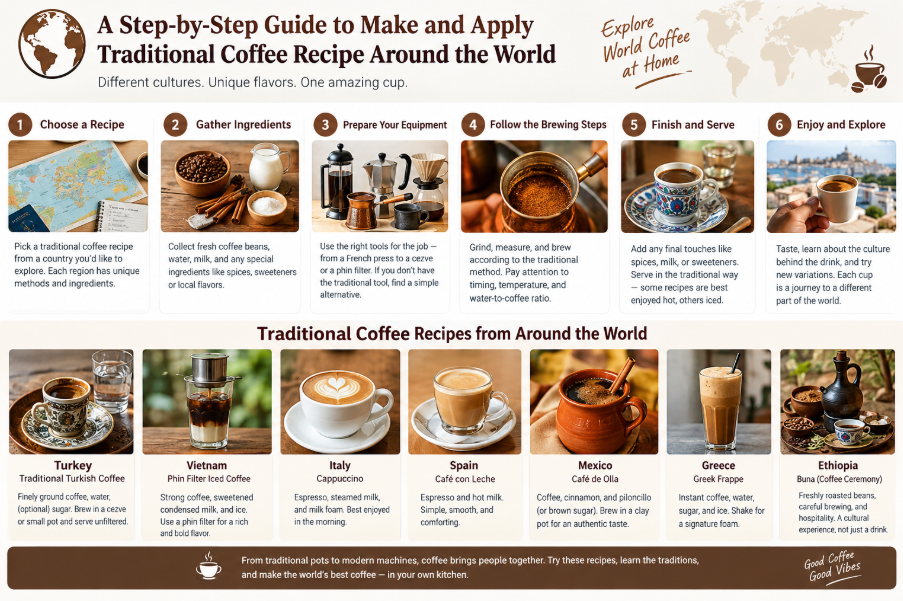
Top Global Coffee Recipes to Brew at Home Easily: Step by step Guides
Coffee is more than a morning drink. Every country has its own way of turning roasted beans into a ritual. Around the world, different cultures have developed unique brewing methods, ingredients, and traditions that turn ordinary coffee into something special. From the rich sweetness of Vietnamese iced coffee to the creamy texture of an Italian cappuccino, every cup offers a different experience.
In this guide to coffee recipe around the world and how to make at home from espresso-bar classics to street-stall favorites, where you also will discover traditional favorites, modern café creations, and practical recipes inspired by international coffee culture.
You do not need a cafe-grade machine for most of them, only the right ratios, a little patience, and a willingness to adjust each cup to your taste. With fresh coffee beans, hot water, milk, and a few simple tools, you can then prepare delicious drinks in your own kitchen.
On the other side, you can also learn type of coffee and how make them at home with this recipe
1. Understanding the Basics of Making Coffee at Home
Before exploring international coffee recipes, it helps to understand how brewing methods affect flavor. Espresso, for example, uses pressure to push water through a compact bed of finely ground coffee, so any bean you like can become espresso.
Other methods, such as Turkish coffee and Vietnamese phin brewing, rely on different techniques to produce distinctive results.
Essential Coffee Equipment
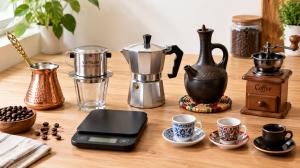
- Coffee grinder: A burr grinder helps produce consistent grounds for different brewing methods.
- Kitchen scale: Measuring coffee and water improves consistency.
- Espresso machine or manual brewer: Choose equipment that matches your preferred drinks.
- Milk frother: Useful for cappuccinos, flat whites, and other milk-based beverages.
- Small saucepan or brewing pot: Helpful for traditional coffee preparations.
The Espresso Recipe Most Baristas Use
If you want to learn how to make every coffee drink, start with three fundamentals: fresh coffee, the correct grind size, and a balanced brewing ratio. The technique includes an espresso coffee-to-water ratio between 1:1.5 and 1:2.5. The manual espresso recipe uses 17 grams of coffee and yields approximately 30 grams of espresso in around 32 seconds.
These figures are starting points rather than universal rules. Taste matters, and different beans, machines, and brewing methods require adjustments. A well-extracted espresso should offer a balance of acidity, sweetness, and other flavor notes rather than overwhelming bitterness.
- Ratio: the SCA suggests roughly 1:1.5 to 1:2.5 coffee to water.
- Dose: a double shot uses about 14 to 17 grams of ground coffee.
- Grind: it should feel like fine sand.
- Water temperature: around 200°F (93°C).
- Time: about 25 to 32 seconds, with taste as the final judge.
Milk Drinks Made Simple
Once you can pull a double shot, the milk drinks follow.
A cortado is a double shot with an equal amount of steamed milk.
A cappuccino has more foam. A flat white sits between the two and uses less aeration.
A latte macchiato reverses the macchiato by staining hot milk with espresso.
Steaming Tip
Keep the wand tip just below the surface to add a little air, then submerge it to create a vortex. Aim for glossy milk that looks like shiny paint.
2. Spain and Italian Coffee Recipes You Can Make at Home
How to Make Authentic Italian Cappuccino at Home Without a Machine
If you are wondering how to make authentic Italian cappuccino at home without machine, use a moka pot for strong coffee. Heat milk and whisk it, or shake it in a sealed jar, until it foams. Pour the coffee first and spoon the foam on top. For summer, the caffè shakerato needs only a double shot that is about 40 to 50 ml, a spoonful of sugar and around 200 grams of ice. Shake hard for 30 to 45 seconds until a frothy head forms. The affogato is even easier: pour a shot of espresso over vanilla ice cream
A cappuccino combines espresso with steamed milk and a generous layer of milk foam. Although a traditional espresso machine makes the process easier, you can prepare a homemade version without one.
Ingredients
- One strong espresso or concentrated coffee serving
- 120 ml milk of your choice
- Optional cocoa powder for serving
Instructions
- Prepare a concentrated coffee using an espresso maker, moka pot, or another suitable brewer.
- Warm the milk in a saucepan without allowing it to boil.
- Froth the milk with a handheld frother or French press. If using a French press, move the plunger repeatedly until the milk becomes foamy.
- Pour the coffee into a cup and add the milk, finishing with a layer of foam.
- Sprinkle with cocoa powder if desired.
The result will not be identical to a professionally extracted espresso cappuccino, but it provides a convenient alternative for home coffee lovers.
How to Make Easy Spanish Café con Leche Recipe With Espresso Machine
Café con leche is a simple combination of coffee and hot milk. It is popular in Spain and is an excellent option for people who enjoy a balanced drink without the thick foam of a cappuccino.
- Brew one or two espresso shots.
- Steam approximately the same amount of milk, adjusting the ratio to taste.
- Pour the milk into the espresso and serve immediately.
You can add a little sugar if you prefer a sweeter cup. A strong moka-pot coffee can also work when an espresso machine is unavailable.
In a simple explanation, to make an easy Spanish café con leche recipe with espresso machine is to pour a single or double shot into a larger cup and top it with steamed milk. Use more milk than in a cortado for a gentler cup
How to Apply Spanish Cortado Recipe at Home
A cortado balances espresso with a smaller amount of milk, allowing the coffee’s flavor to remain prominent. The demonstration describes a double espresso topped with an approximately equal amount of steamed milk.
- Prepare a double espresso.
- Steam a similar volume of milk, introducing only a small amount of air.
- Pour the milk into the espresso and serve in a small glass.
Unlike a cappuccino, a cortado has relatively little foam. It is ideal if you want a strong coffee flavor softened by milk.
Well, a Spanish cortado recipe at home is simple: pull a double shot and add an equal amount of warm milk
How to Make Café Bombón at Home
Café bombón is a sweet Spanish-style coffee made by combining espresso with sweetened condensed milk. Its contrasting layers make it particularly attractive when served in a clear glass.
- Add approximately 30 ml of sweetened condensed milk to a small glass.
- Prepare one espresso shot.
- Slowly pour the espresso over the condensed milk.
- Serve in layers or stir before drinking.
Because condensed milk is already sweet, additional sugar is usually unnecessary.
In a brief statement, to make café bombón at home is by layering equal parts sweetened condensed milk and espresso in a small glass then stir only when you are ready to drink
3. Vietnamese Coffee: Strong, Sweet, and Refreshing
How to Make Vietnamese Phin Filter Iced Coffee Recipe at Home
Vietnamese coffee is traditionally brewed using a small metal drip filter called a phin. Robusta beans are commonly used, producing a strong cup that pairs beautifully with sweetened condensed milk. For an iced version, the hot coffee is poured over ice.
Ingredients
- 25 g ground coffee
- 30 g sweetened condensed milk
- Approximately 100 g hot water
- Ice cubes
Instructions
- Add the condensed milk to a heat-resistant glass.
- Place the ground coffee into the phin filter and gently level the grounds.
- Install the filter insert and pour in the hot water.
- Allow the coffee to drip slowly into the condensed milk. The demonstration notes that this can take five to ten minutes.
- Stir thoroughly, then pour the coffee over a tall glass filled with ice.
It can be concluded that, to make vietnamese phin filter iced coffee recipe at home starts with about 30 grams of sweetened condensed milk in the cup. Add 25 grams of ground coffee to the phin, press the filter lightly, and pour about 100 grams of hot water. Let it drip for 5 to 10 minutes, stir, then pour over a tall glass of ice.
The best coffee beans for homemade Vietnamese iced coffee are dark-roasted Robusta, which gives the bold, bitter backbone that condensed milk balances.
Robusta beans are a traditional choice because their bold flavor stands up well to condensed milk. Medium-dark and dark roasts are also useful options for a rich, chocolatey cup. Choose freshly roasted beans and grind them to suit your phin filter rather than using an espresso-fine powder automatically.
How to Make Vietnamese Egg Coffee at Home
Vietnamese egg coffee is a rich specialty that combines strong coffee with a sweet, creamy egg-yolk topping. It is best approached as a dessert-style drink.
- Brew a small cup of strong coffee.
- Separate one fresh egg yolk and combine it with approximately one tablespoon of sweetened condensed milk.
- Whisk until the mixture becomes pale, thick, and creamy.
- Pour the coffee into a small cup and gently spoon the egg mixture over the top.
Use pasteurized egg products where available, or cook the egg mixture safely, because raw eggs can carry food-safety risks. The topping should be creamy rather than treated as a fully cooked custard unless a suitable cooking method is used.

4. Turkish Coffee: A Traditional Brewing Experience
How to Make Traditional Turkish Coffee at Home Without Cezve
Turkish coffee is known for its exceptionally fine grounds, rich body, and distinctive foam. A traditional cezve, also called an ibrik, is the usual brewing vessel, but a small heat-safe saucepan can be used as an alternative.
Ingredients
- 7 g very finely ground coffee
- 70 ml room-temperature water
- Sugar, optional
Instructions
- Combine the coffee, water, and optional sugar in a small saucepan.
- Stir gently before heating.
- Heat slowly until foam develops and the coffee approaches a simmer.
- Reduce the heat and remove the pan before the coffee boils vigorously.
- Pour carefully into a small cup and allow the grounds to settle before drinking.
Use approximately seven grams of finely ground coffee with 70 grams of water in an ibrik. The key technique is controlling the heat to preserve the foam and avoid excessive extraction. Unlike espresso, Turkish coffee is not filtered before serving.
FYI, Turkish coffee is cooked rather than filtered. Use medium-roasted coffee ground as fine as flour. A traditional ratio is about 7 grams of coffee to 70 grams of cold water per small cup. Heat it gently without stirring, let the foam rise, pour a little foam into each cup, then bring it back up once or twice. Serve it with a glass of water to cleanse the palate.
To make traditional Turkish coffee at home without cezve, a small, narrow stainless-steel saucepan works as a substitute. Keep the heat low and watch closely, because over-extraction makes the cup bitter. Pour gently so the grounds settle in the bottom of the cup
5. Greek Coffee Drinks Frappé and Freddo for Warm Weather
How to Make Traditional Greek Frappe at Home – Step by Step
Greek frappe is a refreshing cold coffee drink with a foamy texture. You will learn a blended variation using coffee, ice, and milk, although traditional Greek frappe is commonly shaken or vigorously mixed with instant coffee, water, and sugar.
Ingredients for a Traditional-Style Frappe
- 2 teaspoons instant coffee
- Cold water
- Sugar, optional
- Ice cubes
- Milk, optional
Instructions
-
- Combine the instant coffee, sugar if desired, and a small amount of cold water in a shaker or tall mixing container.
- Add cold water and a splash of milk if desired.
- Froth with a handheld frother until thick and foamy.
- Shake or whisk until a thick foam forms.
- Fill a tall glass with ice and pour the coffee foam over it.
- Stir gently and serve with a straw.
The modern café freddo uses a double espresso shaken over ice with about a tablespoon of sugar instead of instant coffee. Both are meant to be sipped slowly.
Café Freddo: Chilled Espresso With a Smooth Finish
Another coffee drink associated with Greece and southern Europe is café freddo. In the demonstration, a double espresso is combined with sugar and ice, then shaken to chill and create a smooth, lightly foamy texture. You can also serve chilled espresso over cold milk for a creamier version.
6. Mexican Café de Olla: Coffee With Warm Spices
How to Brew Mexican Café de Olla at Home in a Clay Pot
Café de olla is a traditional Mexican coffee preparation known for its warm spices and sweet flavor. It is commonly associated with cinnamon and piloncillo, an unrefined cane sugar. A traditional clay pot can contribute to the serving experience, but a regular saucepan works too.
Ingredients
- 500 ml water
- 30–35 g medium-coarse ground coffee
- One cinnamon stick
- Approximately 30 g piloncillo, adjusted to taste
Instructions
- Heat the water with the cinnamon and piloncillo until the sugar dissolves.
- Reduce the heat and add the coffee.
- Let the mixture steep briefly without boiling aggressively.
- Remove from the heat and allow the grounds to settle.
- Strain into mugs and serve hot.
How to Make Mexican Café de Olla Recipe Without Piloncillo
If piloncillo is unavailable, substitute brown sugar to approximate its caramel-like sweetness. Honey can also be used, although it changes the flavor. Adjust the amount gradually because the goal is to complement the coffee and cinnamon rather than overpower them.
7. International Coffee Traditions Worth Exploring
How to Make Traditional Senegalese Touba Coffee at Home
If you are curious about how to make traditional Senegalese Touba coffee at home, the signature is spice. Coffee is roasted with selim pepper or grains of Selim and often cloves, then ground and brewed with sugar. The result is peppery, aromatic and slightly sweet. Because selim can be hard to find, you can buy it from West African grocers or specialty importers.
To explore this style at home, brew strong coffee with a small quantity of appropriately prepared Touba spice blend, then strain before serving. The exact spice blend and proportions vary, so use a trusted regional recipe when reproducing a traditional version.
How to Brew Traditional Ethiopian Buna Coffee at Home
Buna is the Ethiopian word for coffee, and Ethiopian coffee culture places considerable emphasis on hospitality and the preparation and sharing of coffee. A home version can begin with freshly roasted and ground coffee brewed in a traditional jebena or another suitable pot.
- Roast green coffee beans if you have the equipment and experience, or begin with freshly roasted beans.
- Grind the beans and combine them with water in a suitable brewing pot.
- Heat carefully, allowing the coffee to develop without excessive boiling.
- Let the grounds settle before pouring small servings.
How to Make an Ethiopian Coffee Ceremony at Home
For a simple home gathering, prepare the coffee fresh, serve it in small cups, and invite guests to share the experience. Traditional ceremonies can include roasting green beans, grinding them, and preparing multiple rounds of coffee. The ceremony is a cultural practice as well as a brewing method, so take time to learn about its traditions rather than treating it as just another recipe.
How to Make Authentic Hong Kong Yuanyang Coffee Milk Tea Recipe at Home
Yuanyang combines coffee with Hong Kong-style milk tea. Its appeal comes from the contrast between robust coffee, strong black tea, and creamy milk.
- Brew a small serving of strong coffee.
- Prepare strong black tea using your preferred method.
- Combine the coffee and tea, starting with roughly equal parts.
- Add evaporated milk or your preferred creamy milk, adjusting sweetness to taste.
- Serve hot or pour over ice.
How to Make Cuban Cafecito at Home
Cuban cafecito is a small, strong coffee traditionally sweetened with a whipped sugar foam known as espumita. Brew a concentrated coffee using an espresso maker or moka pot. Whisk a small amount of sugar with the first few drops of coffee until thick and pale, then combine it with the remaining coffee. Serve in small portions.
In complete tips to learn how to make Cuban cafecito at home, you need a moka pot, dark roast coffee and sugar. Put sugar in a small pitcher. As soon as the first few concentrated drops of coffee appear, pour them over the sugar and whip it briskly until it turns into a pale, peanut-butter-colored paste called espuma. Pour in the rest of the coffee, stir, and serve in small cups. That foamy glaze is the sign you did it right
How to Make German Eiskaffee Recipe at Home With Vanilla Ice Cream
German Eiskaffee is a dessert-like iced coffee made with chilled coffee and vanilla ice cream. A German eiskaffee recipe at home with vanilla ice cream is a cousin of the affogato. Pour strong chilled coffee into a tall glass, add one or two scoops of vanilla ice cream, and top with whipped cream. Vanilla works best because it acts as a plain canvas for the coffee.
- Prepare a cup of strong coffee and chill it completely.
- Place one or two scoops of vanilla ice cream in a tall glass.
- Pour the chilled coffee over the ice cream.
- Add whipped cream if desired and serve immediately.
How to Make Mexico Café de Olla at Home
Traditionally you simmer water with cinnamon and piloncillo, then add coffee. If you want to know how to brew Mexican café de olla at home clay pot style, the clay adds an earthy flavor, and a stainless-steel pot is the modern alternative.
Don’t have piloncillo? A Mexican café de olla recipe without piloncillo can use dark brown sugar with a small spoonful of molasses to mimic its caramelized taste.
How to Make Algeria Mazagran Coffee at Home
Mazagran is a strong, sweet iced coffee served with lemon.
Brew a very strong coffee in a stovetop pot, add sugar while it is hot so it forms a syrup, pour it over ice, and squeeze in lemon or lime. It tastes like a coffee lemonade.
How to Make Australian Flat White at Home
A flat white combines espresso with steamed milk containing a thin layer of fine microfoam. This recipe is for a double espresso served in a small cup, with less aeration than a cappuccino.
- Prepare a double espresso.
- Steam milk while introducing only a little air, then create a smooth, glossy texture.
- Swirl the milk to incorporate larger bubbles.
- Pour it into the espresso, aiming for a creamy drink with a thin layer of microfoam.
Latte art is optional. The most important goal is silky milk that complements the coffee.
In general, an Australian flat white at home recipe uses a double shot in a small cup of about 5 ounces. Steam the milk with a shorter aeration time so it is velvety with only a thin layer of microfoam. Pour from a height at first to mix the milk into the crema, then lower the pitcher to finish. The first sip should taste coffee-forward
8. Tips for Making Better Coffee Tastes at Home
- Grind fresh: a hand grinder is enough to improve almost any recipe.
- Use a scale: consistency begins with measuring dose and yield.
- Watch water temperature: avoid a hard boil, which can harm flavor.
- Purge your grinder after changing grind size.
- Taste and adjust: sweetness and ratios are personal, and traditional recipes vary by region and household.
Frequently Asked Questions
What Is the Easiest International Coffee Drink to Make at Home?
German Eiskaffee, café bombón, and Vietnamese iced coffee are accessible starting points. Each requires relatively few ingredients, although Vietnamese coffee benefits from a phin filter.
Can I Make International Coffee Recipes Without Special Equipment?
Yes. Many recipes can be adapted using a saucepan, French press, moka pot, or ordinary kitchen utensils. However, certain traditional brewing methods produce different results when their usual equipment is replaced.
Which Coffee Beans Should I Buy for International Recipes?
Choose beans according to the drink. Robusta or a strong dark roast works well for Vietnamese iced coffee, while a balanced medium roast can be a good starting point for espresso-based drinks. Freshness and grind consistency matter as much as the origin of the beans.
How Can I Make Coffee Less Bitter?
Adjust the grind size, brewing time, and water temperature, and experiment with a different roast. For milk-based drinks, steamed milk can soften the perceived intensity without requiring additional sugar.
Are All Espresso-Based Drinks Made the Same Way?
No. The espresso may provide the base, but the amount of water, milk, foam, chocolate, or other ingredients changes the drink. A ristretto is a shorter, concentrated extraction, while a lungo uses more water during extraction. A cappuccino has more foam than a flat white, and an Americano combines espresso with hot water.
Why Does My Coffee Taste Bitter?
Over-extraction can contribute to bitterness. Try adjusting the grind, shortening the brewing time, or lowering the temperature where appropriate. In Turkish coffee, for example, vigorous boiling can negatively affect the flavor.
Why Is My Milk Foam Too Bubbly?
Large bubbles often form when too much air is introduced or the milk is not properly incorporated. For espresso-based drinks, introduce a small amount of air near the milk’s surface, then position the steam wand to create a swirling motion. Tap and swirl the pitcher to help remove remaining bubbles.
What If I Don’t Have an Espresso Machine?
A moka pot, French press, handheld frother, phin filter, or saucepan can help you make different styles of coffee at home. The best alternative depends on the recipe. Remember that concentrated coffee from a moka pot is not technically the same as espresso produced under pressure.
Do I need an espresso machine to make these drinks?
No. Moka pots, phin filters, ibriks, French presses and even a saucepan cover most of the recipes above. A machine only helps with drinks like the cortado, flat white and café con leche.
What is the easiest world coffee recipe for beginners?
The affogato and the Greek frappé are the simplest. Each needs only a few ingredients and little equipment.
Which beans should I use?
Match the bean to the drink. Dark roast suits Cuban and Vietnamese coffee, medium roast suits Turkish coffee and espresso drinks, and fresh single-origin beans suit Ethiopian preparations.
Why is my Turkish coffee bitter?
Usually it is over-extracted. Use lower heat and take it off as soon as the foam rises.
Can I make these drinks iced?
Yes. Vietnamese coffee, café freddo, mazagran, yuanyang and the shakerato are all traditionally served cold.
Conclusion: Explore the World One Cup at a Time
Learning coffee recipes from around the world is an enjoyable way to expand your home brewing skills. You can start with a traditional Vietnamese phin filter, experiment with a creamy Spanish café bombón, or prepare a Greek-style cold coffee on a warm afternoon. Each drink offers a different combination of ingredients, texture, and brewing technique.
The most useful lesson is to focus on the fundamentals: measure your ingredients, choose an appropriate brewing method, control your temperature, and adjust the recipe to suit your taste. You do not need professional equipment to begin exploring international coffee culture.
Key Takeaways
-
- Use fresh coffee and consistent measurements for better results.
- Match the grind size and brewing method to the recipe.
- Try Vietnamese iced coffee, Turkish coffee, café bombón, and flat white as starting points.
- Adapt recipes thoughtfully when traditional equipment or ingredients are unavailable.
- Explore cultural context alongside the ingredients and techniques.
- Espresso is a brewing method, and Specialty Coffee Association or SCA ratio is about 1:1.5 to 1:2.5.
- Equipment can be simple: a moka pot, phin or small saucepan often works.
- Sugar, spice and milk ratios vary by region, so season to your own taste.
- Technique, such as foam control, whipping espuma and gentle heat, matters more than expensive gear.
- Many of these drinks can be served hot or iced.
With a few basic tools and a willingness to experiment, you can bring coffee traditions from around the world into your own kitchen, one cup at a time.
Coffee is a global conversation, and your kitchen is a good place to join it. Start with one recipe, learn its technique, then explore another. Each cup teaches you something about the culture behind it.
