
Fix Spraying Espresso: 9 Easy Ways to Stop Channeling
Nothing is more frustrating than starting your morning espresso routine only to watch coffee spray everywhere instead of flowing smoothly into your cup. If you’re using a bottomless portafilter, the problem becomes even more obvious. Instead of a beautiful, slow stream resembling warm honey, you get random jets, splashes, and uneven extraction.
The good news is that spraying espresso is usually fixable without buying an expensive espresso machine or completely replacing your setup. In most cases, the main cause is channeling, which happens when pressurized water finds weak spots in the coffee puck and flows through them unevenly.
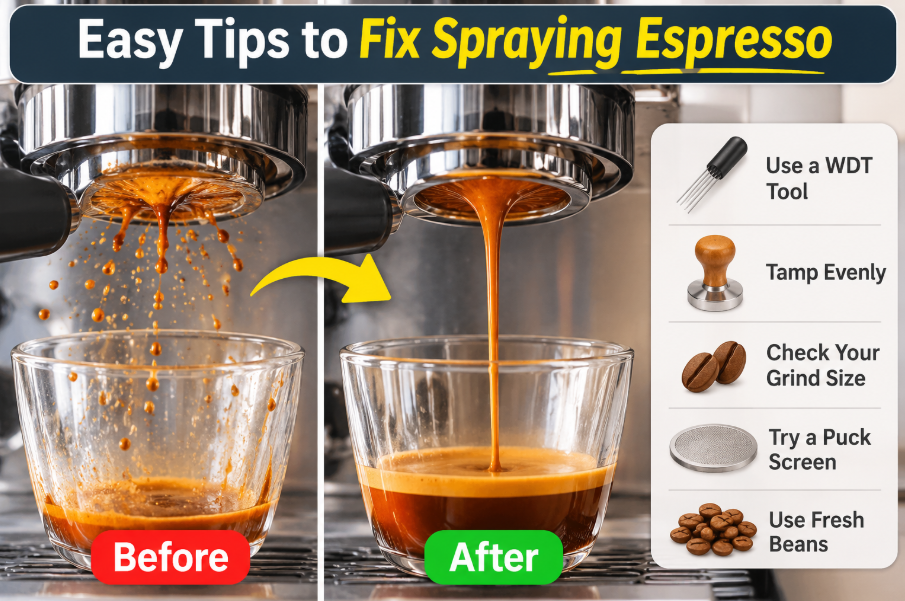
In this guide, we’ll explain how to fix spraying espresso using practical techniques, including WDT distribution, consistent tamping, fresh coffee beans, grind adjustments, and puck screens. We’ll also explore how a bottomless portafilter can help you understand your extraction and improve your espresso technique.
Why Is Your Espresso Spraying Everywhere?
Before fixing the problem, it’s important to understand what’s happening inside your portafilter.
The bottomless portafilter is the “ultimate truth-teller” on the coffee bar. A shot can look textbook-perfect for the first few seconds, with even beading and a heavy, tiger-striped center stream, and then a side jet breaks through mid-extraction. That is classic late-stage channeling, and it points to a small flaw in puck prep.
Espresso machines force hot water through finely ground coffee under pressure. Ideally, the water should pass evenly through the entire coffee puck, extracting flavor at a consistent rate.
However, when coffee grounds are unevenly distributed, clumped together, or poorly tamped, water takes the path of least resistance. It concentrates on weaker areas, creating channels that allow water to move much faster through certain parts of the puck.
This process is called espresso channeling. When using a bottomless portafilter, you’ll see it as thin jets of coffee shooting sideways or random droplets forming across the basket.
Common Causes of Spraying Espresso
- Uneven coffee distribution: Clumps and air pockets create weak spots inside the coffee puck.
- Inconsistent tamping: An angled or uneven tamp allows water to flow more easily through one side.
- Incorrect grind size: Coffee that’s too coarse can produce fast, uneven extractions.
- Stale coffee beans: Older beans may produce thin espresso with inconsistent flow and reduced crema.
- Dirty equipment: Coffee residue and oils can interfere with consistent brewing.
- Damaged or unsuitable baskets: Poorly manufactured or worn baskets may contribute to inconsistent extraction.
On the other side, when people ask why your espresso spraying happens even with good equipment, three culprits show up again and again:
- Micro boulders or clumping: Grinding creates static electricity, which forms tiny dense knots of grounds. If you dump them straight into the basket and tamp, water finds the gaps between clumps.
- The wall effect: Many of us were taught to tap the side of the portafilter to level the grounds. It looks professional, but tapping can dislodge grounds from the basket edges and create a microscopic gap, a high-speed escape route for pressurized water.
- The avalanche effect: Poor distribution does not stay constant. Once water finds the first weak spot, flow velocity at that point skyrockets and erodes the puck, turning a micro crack into a canyon within seconds.
How to Fix Spraying Espresso: 9 Practical Solutions
Again, these easy tips explains the solution how to solve spraying espresso, which is based on the practical advice of several experienced baristas and home-espresso educators. These are the nine most important steps which can be mostly a matter of technique rather than using expensive gear
1. Use a WDT Tool to Break Up Coffee Clumps
One of the most effective ways to prevent channeling is using a Weiss Distribution Technique (WDT) tool. This tool uses thin needles to distribute coffee grounds evenly inside the portafilter basket.
When coffee beans are ground, static electricity and grinder design can cause small clumps to form. These dense clusters create uneven areas in the coffee bed. Simply tamping the grounds without breaking up those clumps can leave gaps where pressurized water escapes.
Here’s how to use a WDT tool:
- Grind your coffee directly into the portafilter using a dosing funnel.
- Insert the WDT needles into the grounds.
- Stir gently throughout the coffee bed using circular and sweeping movements.
- Break up visible clumps and distribute the grounds toward the basket edges.
- Finish with a level coffee bed before tamping.
A WDT tool is particularly useful with home espresso grinders that produce noticeable clumping. It helps create a more uniform coffee puck, reducing the likelihood of water finding weak spots.
2. Tamp Firmly and Evenly
After distributing your grounds, the next step is proper tamping. An uneven tamp can create different levels of resistance across the coffee puck, allowing water to flow more quickly through one side.
Place your portafilter on a stable, flat surface. Position a correctly sized tamper over the basket and press straight down using firm, consistent pressure.
Keep these points in mind:
- Make sure the tamper sits level with the basket.
- Apply consistent pressure rather than pressing harder on one side.
- Avoid twisting aggressively while tamping.
- Use a calibrated tamper if multiple people prepare espresso on the same machine.
Once the coffee bed is properly compressed, additional force generally isn’t necessary. The important thing is achieving a level and repeatable tamp rather than chasing a particular pressure number.
3. Adjust Your Espresso Grind Size
Grind size has a major influence on extraction speed and consistency. If your espresso sprays, gushes, or produces a very thin stream, your grinder setting deserves attention.
A grind that’s too coarse creates larger spaces between coffee particles. Water can move through these spaces too quickly, resulting in a fast extraction and potentially uneven flow.
On the other hand, grinding too fine can restrict water flow excessively, producing very slow shots and potentially contributing to uneven extraction.
A useful starting point is a fine grind with a texture resembling icing sugar or fine sand. However, the ideal setting depends on your beans, grinder, basket, and machine.
Make small adjustments rather than changing several variables simultaneously. If your espresso gushes through the basket, try grinding slightly finer. If the shot takes too long, experiment with a slightly coarser setting.
Get the Right Grind Setting
- Too coarse: shots run through in 10 to 15 seconds. Aim for the texture of talcum powder or icing sugar with a slight sandy graininess between your fingers.
- Too fine: shots crawl, with a Turkish-grind texture. Go back toward a sandier feel.
Also invest in an espresso-focused burr grinder. An old grinder or worn burrs can produce poor particle distribution, which causes channeling even with perfect puck prep. That said, address your puck prep before blaming the grinder.
4. Use a Puck Screen for More Consistent Water Distribution
A puck screen is a thin metal mesh that sits on top of the tamped coffee puck. It helps distribute incoming water across the surface and can reduce direct disturbance of the coffee bed.
To use one, simply:
- Prepare and distribute your coffee grounds.
- Tamp the puck evenly.
- Place a clean puck screen on top.
- Insert the portafilter carefully into the group head.
- Start your extraction as usual.
A puck screen is an optional accessory rather than a guaranteed cure for channeling. It works best as part of good puck preparation, not as a replacement for proper grinding and tamping.
5. Start With Fresh Coffee Beans
Sometimes the problem isn’t your espresso technique at all. Your coffee beans could be responsible.
Freshness plays an important role in espresso quality. Beans that have been sitting on supermarket shelves or stored improperly for months can lose their desirable characteristics and produce flat, uninspiring espresso.
Freshly roasted coffee also releases carbon dioxide during extraction, which contributes to crema development. However, coffee that’s extremely fresh may still need additional resting time after roasting.
A useful starting point is coffee approximately two weeks after its roast date, although the ideal resting period depends on the roast and bean.
For better results:
- Check the roast date before purchasing coffee.
- Store beans in an airtight container.
- Keep coffee away from heat, moisture, and direct sunlight.
- Avoid buying more coffee than you can reasonably use while it’s fresh.
- Experiment with different roast profiles if your current beans consistently produce thin shots.
Here, a home barista experienced persistent spraying and thin espresso despite trying different grind settings. Switching to freshly roasted, darker-roast beans dramatically improved the extraction and eliminated the visible spraying in the shot.
This doesn’t mean darker coffee always fixes channeling. It shows why changing beans can be a useful diagnostic step when other adjustments aren’t producing the expected results.
6. Follow a Consistent Espresso Recipe
Another important step is establishing a repeatable espresso recipe. Your dose, yield, and extraction time work together to determine how your espresso behaves.
A practical starting recipe for a double espresso is:
- Dose: 18 grams of ground coffee.
- Yield: 36 grams of espresso.
- Brew ratio: 1:2.
- Extraction time: Approximately 25–32 seconds.
These numbers are a starting point, not universal rules. Different beans and espresso machines may require adjustments.
Use a digital coffee scale to measure both the dose and final yield. This makes it easier to identify whether a grind adjustment or another change improves your extraction.
For example, if your 18-gram dose produces 72 grams of espresso in 30 seconds, your shot is running at a much higher yield than the suggested 1:2 recipe. Adjusting your target yield and grind settings can help bring the extraction under control.
7. Clean Your Portafilter and Flush the Group Head
Keeping your espresso equipment clean is another simple but often overlooked step.
Coffee oils and old grounds can accumulate inside the portafilter basket and around the group head. Residue may affect the flavor of your espresso and make your brewing routine less consistent.
Before preparing a shot:
- Remove old coffee grounds from the basket.
- Wash and rinse the portafilter.
- Wipe the basket completely dry with a clean towel.
- Briefly flush the group head to remove leftover coffee residue.
- Check that the shower screen is clean.
Also, avoid inserting the portafilter too aggressively. Hitting or knocking it against the group head can disturb the carefully prepared coffee puck and introduce cracks before extraction begins.
8. Check Your Portafilter Basket and Dose
If you’ve already improved your distribution and tamping but your espresso continues to spray, inspect your basket.
Some baskets have different hole patterns, capacities, and manufacturing tolerances. A damaged or poorly manufactured basket may contribute to inconsistent flow.
Precision baskets from manufacturers such as IMS and VST are popular options among espresso enthusiasts. They may offer more consistent manufacturing and provide another variable to explore when troubleshooting persistent extraction problems.
However, upgrading your basket should not be the first step. Correct puck preparation and fresh coffee are usually more sensible starting points.
Also, make sure your coffee dose matches the basket size. Different portafilters require different doses depending on their diameter and basket depth.
For example, these machine-specific starting examples for the basket size:
- 54 mm baskets: Approximately 18 grams for the standard basket and around 20.5 grams for certain deeper bottomless baskets.
- 51 mm baskets: Approximately 16.5 grams for the referenced DeLonghi setup.
Always check the recommended capacity of your particular basket. These measurements are examples, not universal dosing specifications.
9. Experiment With One Variable at a Time
If you’ve tried everything and still experience spraying, avoid changing several things simultaneously.
Instead, approach espresso troubleshooting systematically. Pull a shot, observe the flow, taste the result, and adjust one variable before preparing the next shot.
For example, you might keep your dose and yield consistent while making a small grind adjustment. If the shot improves, you’ve identified a potentially useful change.
Some espresso machines also allow pressure adjustments or profiling. These can influence extraction, but it’s best to establish consistent puck preparation and grind settings before experimenting with more advanced techniques.
How to Fix Bottomless Portafilter Spray Espresso
A bottomless portafilter, sometimes called a naked portafilter, removes the traditional spouts underneath the basket. This exposes the entire underside of the coffee basket, making it easier to observe the extraction.
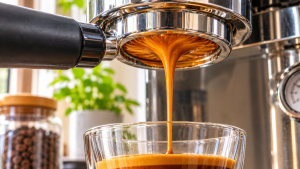
When everything is prepared correctly, espresso should emerge relatively evenly from the basket and converge toward the center into a smooth stream.
If you notice random jets, droplets, or coffee shooting sideways, it’s a strong indication that something in your preparation or extraction needs attention.
What a Good Bottomless Extraction Looks Like
- Small droplets begin forming relatively evenly across the basket.
- The droplets gradually merge into a central stream.
- The flow remains reasonably consistent throughout extraction.
- The espresso develops an attractive crema without excessive spraying.
Remember that a few small droplets don’t automatically mean your espresso is ruined. The overall flow, extraction time, and taste matter more than achieving a visually perfect shot every time.
On the other hand, if you want to know how to fix bottomless portafilter spray espresso for good, the small habits around your three core steps matter just as much.
a. Start With the Right Dose and Basket
A scale is a must, because you need to weigh your dose every time. Typical starting points are:
- 54 mm portafilter (such as the Barista Express): about 18 g, while compatible bottomless baskets are often deeper and take roughly 20.5 g.
- 51 mm portafilter (many budget machines): about 16.5 g.
At this point, a bottomless basket sometimes needs a grind setting one step finer than a spouted one, so be prepared to adjust.
b. Clean and Dry Your Gear
- Wash and wipe your portafilter with a dry towel before use. Residue and oils affect water flow through the puck and lead to inconsistent extraction.
- Flush your group head before pulling the shot to clear leftover residue and promote more even extraction.
- Insert the portafilter gently. Knocking it into the group head can disturb the grounds inside.
c. Skip the Side Taps
After dosing, give the basket at most a light tap on the counter, then rely on your WDT tool to level the bed. Avoid repeatedly tapping the portafilter’s side, for the wall-effect reason described above.
How to Use Bottomless Portafilter to Improve Espresso Technique
One of the biggest advantages of a bottomless portafilter is that it makes hidden extraction problems visible.
With a traditional spouted portafilter, coffee from different parts of the basket combines inside the spouts. This can hide channeling and uneven flow.
A bottomless version gives you a direct view of what’s happening. You can observe where spraying begins, whether one side extracts faster, and how your WDT technique or tamping changes affect the final shot.
Use it as a diagnostic tool:
- Pull a shot using your normal preparation routine.
- Watch for uneven droplets or sudden spurting.
- Identify whether spraying begins immediately or later in extraction.
- Adjust distribution, tamping, or grind size.
- Repeat the extraction and compare the results.
Read the Extraction
An ideal shot flows evenly from the whole basket and converges into a single central stream. Watch for spurts, dead spots and areas that are not contributing. With a spouted portafilter, channeling is out of sight and out of mind. A bottomless one shows you the impact of each change in real time, whether it is a new distribution tool, a different tamp or a grind adjustment.
For example, try to pull 12 consecutive naked shots on a spring lever machine and analyze many spurts coming from the same spot in the basket, around the 2 o’clock position, which points to a recurring tamping or distribution flaw you never have noticed with a spouted portafilter. Try increasing the dose slightly, tamping harder, and making one small grind adjustment to finally produce a clean 26-second shot, which you can then repeat.
Other Benefits of Going Bottomless
- More clearance: removing the spouts adds an inch or more of space for scales and larger cups, which helps on compact machines.
- Hotter shots: in one temperature test, a bottomless portafilter produced espresso at a little over 197°F, compared with about 186°F for a metal double-spouted portafilter.
- Less dripping and easier cleaning: there are no spouts to pool water or espresso, and you can wipe the basket underside to prevent oil build-up.
Why Does Espresso Start Spraying in the Middle of Extraction?
Not every spraying problem appears immediately. Sometimes an espresso shot starts beautifully, with an even flow and attractive tiger-striped crema, before suddenly developing a high-pressure jet.
This can indicate late-stage channeling.
As extraction progresses, water continues flowing through the coffee puck under pressure. If a weak spot develops, water can begin eroding the surrounding coffee particles. A small channel may gradually become larger, creating a sudden spray.
This is why you should observe the entire extraction rather than judging your preparation by the first few seconds alone.
Late-stage spraying can point toward small inconsistencies in puck distribution or tamping, even when the final espresso still tastes reasonably good.
Common Mistakes That Make Espresso Channeling Worse
Sometimes the problem comes from habits that seem helpful but actually make puck preparation less consistent.
a. Tapping the Portafilter Too Hard
Repeatedly tapping the side of the portafilter can disturb grounds around the basket edges. This may create small gaps between the coffee bed and basket wall, giving water an easier route through the puck.
Instead, use gentle movements and a WDT tool to distribute the coffee evenly.
b. Changing Too Many Variables at Once
Changing your dose, grind size, tamping pressure, and extraction time simultaneously makes troubleshooting difficult. You won’t know which adjustment actually improved the shot.
c. Assuming a Puck Screen Will Fix Everything
A puck screen can support more consistent water distribution, but it cannot compensate for badly clumped grounds, uneven tamping, or an unsuitable grind setting.
d. Ignoring Coffee Freshness
Even excellent espresso equipment cannot turn stale coffee into consistently delicious espresso. Always consider bean freshness when troubleshooting thin or unpredictable shots.
Frequently Asked Questions
1. How to fix spraying espresso quickly?
Start by using a WDT tool to break up coffee clumps, distribute the grounds evenly, and tamp firmly with a level tamper. Then check your grind size and dose. These adjustments address several of the most common causes of espresso channeling.
2. How to fix bottomless portafilter spray espresso?
Focus on puck preparation first. Use fresh beans, distribute the grounds with a needle tool, tamp evenly, and consider adding a puck screen. If spraying continues, experiment with your grind setting and inspect the basket for damage.
3. How to fix espresso channeling issues without buying new equipment?
You can improve extraction without purchasing expensive accessories. Distribute your grounds carefully, tamp on a flat surface, use consistent coffee measurements, keep your equipment clean, and make small grind adjustments. These basic techniques can make a significant difference.
4. Why your espresso spraying even after tamping correctly?
Proper tamping alone doesn’t guarantee even extraction. Coffee clumps, uneven distribution, stale beans, an unsuitable grind size, or a poorly manufactured basket can still cause channeling. Check your entire puck preparation process rather than focusing only on tamping.
5. How to fix bottomless portafilter overspray caused by stale beans?
Try using freshly roasted coffee with a clearly marked roast date. Beans that are too old may produce thin espresso with reduced crema and unpredictable extraction. Experiment with a fresh medium or darker roast while keeping your other brewing variables consistent.
Always aim for coffee roughly two weeks from its roast date, and store it in an airtight container.
Note: Switching to a fresh, darker-roasted local bean, along with a paper filter under the puck, eliminated the spray entirely. Their previous beans had produced about 72 g of liquid in a 30-second pull, which is far too fast. The lesson is that beans which are stale, or too light for your machine and grinder, can cause gushing even when everything else is right.
6. Why is your espresso shot spurting everywhere?
Your espresso shot is probably experiencing channeling. Water is finding weak spots in the coffee puck and escaping through them under pressure. Uneven distribution, coffee clumps, poor tamping, and unsuitable grind settings are common reasons.
7. Does a puck screen prevent espresso spraying?
No. A WDT tool, even tamping and fresh coffee matter more. A puck screen is a helpful extra.
A puck screen can help distribute incoming water more evenly and protect the coffee bed from direct disturbance. However, it doesn’t guarantee that spraying will disappear. Proper grinding, distribution, and tamping remain essential.
8. Is a bottomless portafilter better than a spouted portafilter?
Neither is automatically better for every situation. A bottomless portafilter is particularly useful for diagnosing channeling because you can see the extraction directly. A spouted portafilter is often more convenient for splitting espresso into multiple cups and keeping the brewing area cleaner.
9. Should I grind finer if my espresso sprays?
Not necessarily. If your shot is running too quickly, a slightly finer grind may help increase resistance. However, spraying can also come from uneven puck preparation. Correct distribution and tamping before making significant grind adjustments.
10. Does spraying always mean my shot tastes bad?
Not always. Some shots with minor spurts still taste decent, but spurts signal uneven extraction and room for improvement.
11. Can stale coffee cause my espresso to spray?
Yes. Stale or mismatched beans can cause fast, thin, gushing shots, so use fresh coffee stored airtight.
12. Should I tap the side of the portafilter to level the grounds?
It is better to avoid it. Tapping can create gaps at the basket walls that water escapes through.
Final Thoughts: Get Rid of Spraying Espresso for Good
Learning how to fix spraying espresso is mostly about improving consistency. Channeling can make an otherwise promising espresso shot look messy and taste unbalanced, but you don’t need an expensive machine upgrade to address it.
Start with the fundamentals: use fresh coffee beans, distribute your grounds with a WDT tool, tamp evenly, and measure your dose and yield. A puck screen and precision basket can be useful additions, but they should come after you’ve established a reliable preparation routine.
If you’re using a bottomless portafilter, pay attention to the entire extraction. The way coffee flows can reveal problems that would otherwise remain hidden behind traditional portafilter spouts.
Key Takeaways
-
- Use a WDT tool to break up clumps and distribute coffee grounds evenly.
- Tamp firmly and evenly, and level with the basket then consider a puck screen.
- Adjust grind size gradually to control extraction speed.
- Choose fresh coffee beans around two weeks from roast and store them properly then use a 2:1 recipe, and a grind between talcum powder and sand.
- Use a digital scale to maintain a consistent dose and yield.
- Clean your portafilter and flush the group head regularly.
- Use a bottomless portafilter to identify visible channeling.
- Change one brewing variable at a time to understand what improves your espresso.
- Spraying is caused by channeling, when water finds the path of least resistance.
- Weigh your dose, wash and dry the portafilter, flush the group head, and insert the portafilter gently.
- Avoid tapping the side of the portafilter.
- Use the bottomless portafilter as a diagnostic tool to refine your technique shot by shot.
With a little patience and consistent preparation, you can turn those messy, spraying extractions into smoother, more controlled espresso shots that taste as good as they look.
A spraying shot is not a failure. It is feedback. Fixing it comes down to a handful of consistent habits: break up clumps, tamp level and firm, keep your equipment clean, use fresh coffee, and dial in a sensible recipe. Once you master these, the bottomless portafilter rewards you with a clean, honey-like stream.
