
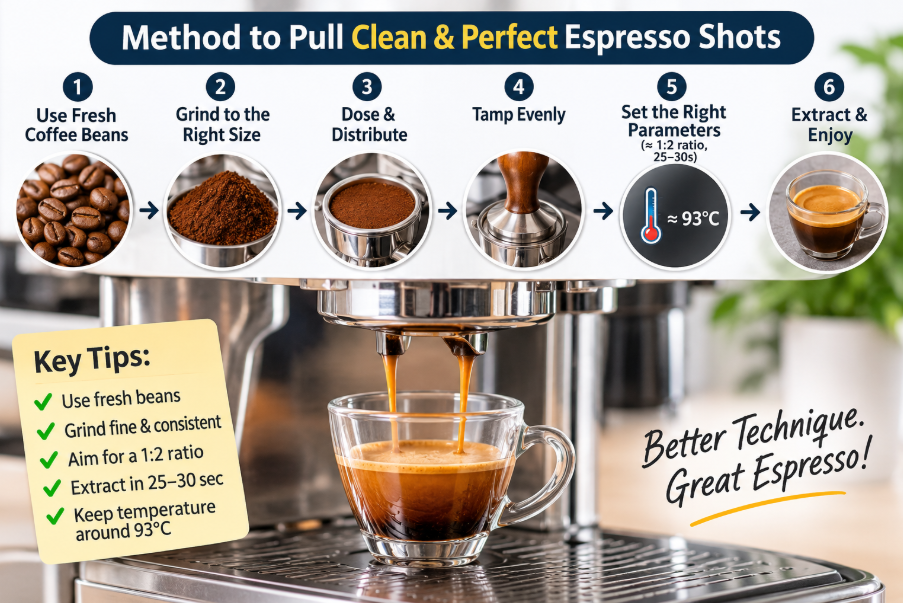
How to Make the Cleanest & Perfect Espresso Shots at Home
Making the cleanest espresso shots isn’t simply about producing thick crema or achieving a perfectly timed extraction. It’s about finding the right balance between sweetness, clarity, body, and flavor. Whether you’re a beginner learning the basics or an experienced home barista experimenting with advanced brewing techniques, understanding a few essential variables can dramatically improve your espresso.
Modern espresso preparation has evolved considerably. Traditional espresso recipes are still popular, but techniques such as turbo shots, paper-filtered extractions, and coarser grinding are changing how coffee enthusiasts think about extraction. Some specialty coffee shops are even experimenting with espresso-style coffee that resembles hand-brewed coffee in its clarity and drinkability.
In this guide, we’ll explore how to make the cleanest espresso shots, explain the fundamentals of extraction, and share practical techniques for achieving consistent results at home.
1. Start With Fresh, High-Quality Coffee Beans
The quality of your coffee beans is arguably the most important factor in making excellent espresso. Even an expensive espresso machine cannot compensate for stale beans or poor-quality coffee.
Freshly roasted whole beans contain aromatic compounds and carbon dioxide that contribute to flavor development and crema formation. Pre-ground coffee loses its aroma much faster because more of its surface area is exposed to oxygen.
For the best results, consider purchasing beans from a local specialty coffee roaster. Look for a clearly printed roast date rather than relying exclusively on an expiration date.
How Fresh Should Espresso Beans Be?
Many coffees benefit from a resting period after roasting. Around two to four weeks after the roast date can be a useful starting point, although the ideal resting period depends on the coffee and roasting style.
Store your beans in an airtight container away from direct sunlight, heat, and excessive moisture. Grind immediately before brewing whenever possible.
Choose Beans That Match Your Taste
- Light roasts: Often produce floral, fruity, and tea-like characteristics but can require more careful extraction.
- Medium roasts: Offer a balance of sweetness, acidity, and body.
- Dark roasts: Usually produce stronger chocolate, caramel, and roasted flavors and may extract more easily.
- Single-origin coffees: Allow you to explore distinctive flavor characteristics from specific growing regions.
For particularly clean and expressive espresso, try specialty coffees with naturally floral, citrus, or berry-like characteristics.
2. Understand the Three Fundamentals of Espresso
If you’re wondering how to pull great espresso shot after shot, begin with three fundamental variables: dose, yield, and time. These three measurements form the foundation of a repeatable espresso recipe.
Dose: How Much Coffee Goes Into the Basket?
Dose refers to the weight of dry coffee grounds placed inside the portafilter basket. Your basket determines the appropriate starting amount.
- Single basket: approximately 7–10 grams.
- Double basket: approximately 16–18 grams.
- Triple basket: approximately 20–22 grams.
For a typical home espresso setup, 18 grams is a practical starting dose for a double basket. However, always check the manufacturer’s recommended basket capacity.
Yield: How Much Espresso Comes Out?
Yield measures the weight of liquid espresso produced during extraction. Measuring by weight is more reliable than measuring by volume because crema makes volume measurements inconsistent.
Espresso recipes are commonly expressed as ratios between dry coffee dose and liquid output.
- 1:1 ratio: Produces a concentrated ristretto-style extraction.
- 1:1.5 ratio: Creates a shorter, concentrated espresso.
- 1:2 ratio: A popular starting point for traditional espresso.
- 1:3 ratio: Produces a longer, less concentrated espresso.
For example, using 18 grams of coffee with a 1:2 ratio means targeting approximately 36 grams of espresso.
Time: How Long Should Espresso Extraction Take?
Extraction time determines how long water interacts with the coffee grounds. A useful starting point for traditional espresso is approximately 25–35 seconds, although different coffees and recipes can require considerably different times.
Start your timer when water first contacts the coffee puck, typically when you activate the brewing cycle. Adjust the grind size to help achieve your desired yield within an appropriate time.
3. Choose the Right Grind Size
Grind size controls the resistance water encounters as it passes through the coffee puck. A finer grind generally increases resistance and slows extraction, while a coarser grind allows water to flow more quickly.
For traditional espresso, the grind should generally be fine enough to provide sufficient resistance without choking the machine.
How to Adjust Your Grinder
- If your shot reaches the target yield too quickly, adjust the grinder slightly finer.
- If your shot takes too long, adjust the grinder slightly coarser.
- If extraction time is correct but the coffee tastes unpleasant, evaluate the flavor before making additional adjustments.
Remember that grinder settings are not universal. Different beans, roast levels, humidity, and coffee age can all affect extraction. Even when purchasing the same coffee regularly, small adjustments may be necessary.
Why Grinder Quality Matters
A good espresso grinder should produce reasonably consistent particle sizes and allow small adjustments. You don’t necessarily need an expensive commercial grinder to make excellent espresso at home, but having adequate grind control makes dialing in considerably easier.
4. Prepare the Coffee Puck Properly
Uneven puck preparation can cause channeling, where water finds easier pathways through the coffee instead of extracting evenly across the entire puck.
Good puck preparation improves repeatability and helps produce cleaner, more balanced espresso.
Use a WDT Tool to Distribute Grounds
Freshly ground coffee can contain clumps. A Weiss Distribution Technique (WDT) tool uses fine needles to break apart these clumps and distribute grounds more evenly inside the portafilter.
If you don’t have a WDT tool, gently distributing the grounds manually can still help.
Tamp Level and Consistently
Place your tamper into the basket and apply firm, even pressure. The goal is to create a flat, compact coffee puck that provides consistent resistance to incoming water.
You don’t need to obsess over achieving a particular tamping pressure. Consistency and keeping the tamper level are more important than pressing excessively hard.
Consider These Additional Puck Preparation Tools
- WDT tool: Breaks up clumps and distributes coffee grounds.
- Puck screen: Helps distribute incoming water and can reduce residue on the group head.
- Calibrated tamper: Helps produce consistent, level tamping.
- Precision basket: Can provide more consistent geometry and extraction behavior.
These accessories can improve workflow, but they aren’t essential for making good espresso.
5. Maintain Consistent Brewing Temperature
Water temperature has a significant influence on espresso flavor. A commonly used brewing range is approximately 195–205°F (90–96°C), although the ideal temperature depends on the coffee and extraction recipe.
Higher temperatures can encourage greater extraction, while lower temperatures may produce a different balance of acidity, sweetness, and bitterness.
Warm Up Your Espresso Machine
Give your espresso machine enough time to reach a stable operating temperature. Depending on the machine, this may take approximately 15–30 minutes.
Keep the portafilter locked into the group head during warm-up so that the metal components reach a similar temperature.
Adjust Temperature According to Your Machine
- PID-controlled machines: Set your preferred brewing temperature and allow the machine to stabilize.
- Heat-exchanger machines: A cooling flush may help manage overheated water, depending on the machine.
- Single-boiler machines: Follow the manufacturer’s recommended temperature-management and flushing procedure.
Consistency matters more than constantly changing the temperature. Establish a reliable baseline before experimenting.
6. Experiment With Paper Filters for Cleaner Espresso
One particularly interesting technique demonstrated in specialty coffee shops is using paper filters to produce exceptionally clear coffee.
This method takes espresso in a different direction. Instead of focusing exclusively on traditional crema and concentrated body, it emphasizes clarity, flavor separation, and drinkability.
The Coffee Soup Technique
In the demonstration at Big Sir coffee shop, the baristas prepared a distinctive coffee drink they called coffee soup. The recipe used approximately 17 grams of coffee, a very coarse grind, and a high-flow basket.
They placed paper filters both above and below the coffee puck. This double-filtration approach helped produce a remarkably clear beverage.
The brewing temperature was approximately 86°C, with relatively low pressure and a target output of around 90 grams from 17 grams of coffee. That represents an approximately 1:5.3 ratio.
The resulting drink had impressive clarity, sweetness, and layered flavors without the conventional appearance of espresso crema.
Why Double Filtration Makes a Difference
Paper filtration can retain fine coffee particles and some oils, creating a cleaner-looking beverage with a lighter texture. The combination of coarse grinding, high flow, and filtration can highlight delicate flavor characteristics.
The baristas demonstrated this approach with coffees including Panama Bambito Estate and Barbados Highland Grace Geisha. The Geisha coffee displayed floral, bergamot, and juicy characteristics.
Importantly, coffee soup is an experimental espresso-style preparation rather than a standard espresso recipe. Its unusual grind size, pressure, temperature, and output should not be confused with conventional espresso dialing-in.
7. How to Get a Turbo Espresso Shot
Turbo shots are another interesting development in modern espresso preparation. Originally described in the scientific study Systematically Improving Espresso, this technique uses a coarser grind, lower dose, and significantly shorter extraction time.
Basic Turbo Shot Recipe
- Coffee dose: 15 grams.
- Grind size: Coarser than traditional espresso.
- Target yield: Approximately 40 grams.
- Extraction time: Approximately 15 seconds.
The idea behind turbo shots is to reduce the unpredictability associated with highly restrictive traditional espresso pucks. A coarser grind can produce more repeatable flow and potentially reduce the effects of channeling.
What Does a Turbo Shot Taste Like?
Turbo shots can produce impressive sweetness, clarity, and drinkability. They may have less density and texture than conventional espresso, but their shorter extraction time doesn’t automatically mean poor extraction.
Some turbo-shot experiments have achieved extraction yields around 18–19%, demonstrating that a short brewing time can still produce a properly extracted beverage.
Try a Hybrid Turbo Shot
If you enjoy the clarity of turbo shots but prefer more traditional espresso texture, experiment with a hybrid recipe.
- Dose: 17 grams.
- Grind: Slightly finer than a standard turbo shot.
- Yield: Approximately 40 grams.
- Time: Approximately 18–20 seconds.
This variation aims to retain the sweetness and repeatability of turbo shots while adding more texture, intensity, and balance. Adjust the recipe according to your beans and personal taste.
8. Single, Double, Ristretto, and Normale Espresso Explained
Understanding different espresso styles makes it easier to choose the right recipe for your preferred drink.
Single Espresso
A single espresso traditionally uses approximately 7–10 grams of coffee and produces a smaller serving. It requires a compatible single basket and careful dosing.
Many experts recommend pulling a double and discarding half, since a single basket gives less time for proper extraction. If you prefer singles, these single shot espresso tips will help:
- Take half your double dose and add 0.5 to 1 g. If you use 18 g for a double, try 9.5 g.
- Distribute carefully and break clumps to avoid channeling.
- Use fresh beans. In one test, older beans produced a sour 23 g shot; grinding finer brought the yield to 21.8 g and improved the taste.
Double Espresso
A double espresso typically uses 16–18 grams of coffee, although basket sizes vary. It produces a larger serving and is a convenient starting point for home espresso recipes.
Ristretto
A ristretto uses a shorter yield relative to the dose. For example, 18 grams of coffee producing 18–27 grams of espresso creates a concentrated extraction.
Normale
Normale refers to a more conventional espresso extraction. A 1:2 ratio, such as 18 grams in and 36 grams out, is a useful starting point.
These styles aren’t strict rules. Different coffee beans respond differently, so experimentation is essential.
9. How to Fix Your Bad Espresso Shots
Even experienced baristas occasionally produce sour, bitter, weak, or inconsistent espresso. The important thing is learning to identify the problem and change the appropriate variable.
This is a solution to fix espresso to bitter or sour issue, so you can pull your perfect shots at home
If you’re wondering <strong>how to fix your bad espresso shots</strong>, diagnose by taste and timing.
Problem: Espresso Tastes Too Sour
Sourness can indicate under-extraction, especially when the shot runs too quickly. Sourness is sharp and makes you wince. A shot that finishes in 10 to 12 seconds is usually under-extracted, so grind finer. Taste-wise, you can also increase the yield, for example from 30 g to 40 g
- Try grinding slightly finer.
- Check that your coffee dose is consistent.
- Consider increasing the extraction yield.
- Check for uneven puck preparation and channeling.
Problem: Espresso Tastes Too Bitter
Excessive extraction can produce unpleasant bitterness. Bitterness is pungent and unpleasant. A shot that drips for 45 seconds is over-extracted, so grind coarser or reduce your yield, for example from 30 g to 25 g.
- Try grinding slightly coarser if the shot runs too slowly.
- Consider reducing the output yield.
- Check whether your brewing temperature is appropriate.
- Make sure your beans aren’t excessively dark or stale.
One home barista started a new blend at setting 10 and got a sour 12-second shot. Moving two steps finer was too much, producing a slow, bitter shot. One step coarser landed at 23 seconds with rich crema and balanced flavor.
Problem: Espresso Runs Too Quickly
Fast extraction often means the coffee puck isn’t providing enough resistance.
- Adjust the grinder finer.
- Check your basket dose.
- Improve coffee distribution before tamping.
- Look for signs of channeling.
Problem: Espresso Runs Too Slowly
If coffee drips out slowly or the machine struggles to extract, the grind may be too fine or the basket may be overfilled.
- Adjust the grinder slightly coarser.
- Check the basket’s recommended capacity.
- Ensure the coffee puck isn’t excessively compacted with too much coffee.
- Check that the machine and basket are clean.
Problem: Uneven Extraction and Channeling
Channeling occurs when water flows through specific areas of the coffee puck more easily than others. This can produce a shot that tastes sour and unbalanced even when the extraction time appears correct.
A bottomless portafilter makes diagnosing channeling easier. Watch for uneven streams, spraying, or coffee emerging disproportionately from one side.
Try improving distribution with a WDT tool. Interestingly, slightly coarsening the grind may also help in certain cases by reducing excessive puck resistance.
If coffee spurts from one side of a bottomless portafilter, or flows quickly after a long delay, water is finding a path of least resistance. Improve distribution and tamp levelness. If the shot hits the right time but tastes sour, going slightly coarser can reduce pressure and even out extraction.
10. Essential Tips for Consistent Home Espresso
Once you’ve established a reliable recipe, the next challenge is repeating it every day. These practical habits can help you achieve more consistent results.
- Use fresh, properly stored coffee beans.
- Weigh your coffee dose instead of relying on volume.
- Use a grinder that offers precise adjustments.
- Distribute grounds evenly before tamping.
- Keep your tamper level and apply consistent pressure.
- Preheat your machine and portafilter.
- Measure your espresso yield using a digital scale.
- Change one brewing variable at a time.
- Record successful recipes for future reference.
- Clean your portafilter, basket, and group head regularly.
A bottomless portafilter is also a useful diagnostic accessory, although you can achieve excellent results using a conventional spouted portafilter.
Frequently Asked Questions
1. What is the best ratio for clean espresso shots?
A 1:2 ratio is an excellent starting point for traditional espresso. For example, use 18 grams of coffee to produce approximately 36 grams of espresso. Adjust the ratio depending on your preferred sweetness, body, and acidity. Use smaller ratios for darker roasts and larger ones for lighter roasts.
2. How long should a perfect espresso shot take?
Approximately 25–35 seconds is a useful starting range for traditional espresso. However, turbo shots and other experimental recipes can produce excellent results in considerably less time.
3. What grind size produces the cleanest espresso?
Traditional espresso generally requires a fine grind that provides adequate resistance. However, experimental preparations such as turbo shots and coffee soup use coarser grounds to emphasize flow consistency and clarity.
4. Do I need an expensive espresso grinder?
No. An affordable grinder can produce good espresso if it offers sufficient grind control and reasonably consistent particle sizes. Fresh beans, accurate dosing, and proper dialing in are more important than buying expensive equipment immediately.
5. Why does my espresso have no crema?
Stale beans, insufficient freshness, inappropriate grind size, and extraction problems can all contribute to poor crema. Start by checking your beans and making sure they’re suitable for espresso.
To know more about crema on your espresso, learn how to create a thick crema on your espresso with a simple tip
6. What is the difference between a turbo shot and traditional espresso?
A turbo shot typically uses a 15-gram dose, a coarser grind, approximately 40 grams of output, and around 15 seconds of extraction. Traditional espresso generally uses a finer grind and a longer extraction time.
7. Can paper filters make espresso taste cleaner?
Yes. Paper filters can retain fine particles and some oils, producing a cleaner and more defined beverage. Double filtration, as demonstrated in the coffee soup preparation, can further emphasize clarity.
8. How can I make my espresso shots more consistent?
Use the same coffee dose, maintain a consistent grind distribution and tamp, stabilize brewing temperature, and weigh your output. Adjust only one variable at a time when dialing in a new coffee.
9. How fresh should my beans be?
Roughly 5 to 14 days off roast is ideal, and within two months is still workable. Pre-ground and very old coffee loses aroma and crema.
Conclusion: Find Your Perfect Espresso Recipe
Learning how to make the cleanest espresso shots is about understanding extraction rather than relying on expensive equipment or chasing a particular appearance. Fresh coffee beans, accurate dosing, appropriate grind size, consistent puck preparation, and stable brewing temperature provide the foundation for excellent espresso.
Traditional espresso remains a fantastic starting point, but experimenting with turbo shots, paper filtration, and different extraction ratios can reveal entirely new dimensions of your coffee.
Most importantly, don’t be afraid to experiment. Taste your espresso, identify what you like and dislike, and make small adjustments until you find your own ideal recipe. The best espresso isn’t necessarily the one with the thickest crema or the longest extraction. It’s the one that delivers the flavor, clarity, sweetness, and texture you enjoy.
Key Takeaways
- Start with fresh, high-quality whole coffee beans, ideally 5 to 14 days off roast.
- Understand dose, yield, and extraction time.
- Use a consistent grind and level tamp.
- Maintain stable brewing temperatures.
- Experiment with turbo shots and paper filtration for additional clarity.
- Adjust one variable at a time when troubleshooting.
- Prioritize flavor and repeatability over expensive equipment.
- Master dose, yield and time using a scale.
- Dial in with the grinder and change one variable at a time.
- Level tamping and consistent prep matter more than pressure.
- Ristretto is about 1:1 and normale is about 1:2.
- Sour usually means too fast; bitter usually means too slow.
- Paper filters, coarse grinds and lower temperatures produce exceptionally clean cups.
Clean, delicious espresso isn’t magic. It’s the result of fresh beans, accurate weights, a level puck, controlled temperature and patient grind adjustments. Once you master the fundamentals, you can explore turbo shots, ristrettos or paper-filtered “coffee soup” to find your own tasty point.
