
Gas Burner Coffee Bean Roaster Machine: KALDI vs. ICZW vs. DYVEE: Which Gas Coffee Roaster Should You Buy?
There is something uniquely satisfying about roasting coffee beans yourself.
You can watch the beans change color, listen for the first crack, adjust the heat, and ultimately brew coffee that is fresher and more customized than many pre-roasted options.
For home enthusiasts and small coffee businesses, a gas-powered roaster can offer the hands-on control needed to experiment with different roast levels.
But with so many beans roaster machines available, choosing the right one comes down to capacity, heat control, portability, construction, and how often you plan to roast.
A gas burner coffee bean roaster for home use is worth considering if you want more control over the roasting process without committing to a large commercial machine.
Gas burners can provide responsive heat adjustment, allowing users to increase or reduce heat as the roast progresses.
This can be particularly useful for coffee lovers who want to develop repeatable roasting profiles rather than simply pressing a button and waiting for the machine to finish.
For beginners or people with limited counter space, a small gas burner coffee bean roaster can be an attractive option.
Compact coffee beans raoster machines generally require less storage space and are easier to work with when you’re roasting modest quantities.
They can also be a practical starting point for learning how changes in heat and timing affect the flavor of different green coffee beans.
If you prefer an easily accessible fuel source, a propane gas coffee bean roaster for home can provide flexibility for both indoor setups where permitted and appropriate outdoor roasting areas.
Propane-powered models are especially appealing to users who want a dedicated heat source without relying exclusively on an electric heating element.
Always follow the manufacturer’s ventilation, fuel, and installation requirements when using gas equipment.
Another option worth exploring is an LPG gas coffee bean roaster machine, particularly in regions where LPG is a common household or commercial fuel.
These coffee beans roaster machines can appeal to frequent roasters because gas heat can be adjusted quickly during different stages of the roast.
However, burner compatibility and fuel requirements should always be checked before purchasing.
For people who roast primarily for personal consumption, a gas coffee bean roaster for small batches can offer a sensible balance between capacity and convenience.
Smaller batches let you experiment with different beans without committing large quantities of green coffee to a single roast profile.
A tabletop gas coffee bean roaster can make even more sense for users who have limited workspace.
Its compact footprint can fit into a dedicated roasting area while still providing a more hands-on roasting experience than many basic countertop appliances.
Capacity is another major consideration. You may also want to go for an electric coffee beans roaster under $200 that fits your need for home use
Choosing gas burner coffee beans roaster with 500g capacity may be suitable for serious home users who want enough roasted coffee for several days or multiple brewing sessions.
Meanwhile, a 1kg gas coffee bean roaster machine is better suited to heavier home use, entertaining, or small-scale commercial roasting where larger batches can save time.
Ultimately, gas burner coffee roasters are worth buying when their capacity and control match your roasting goals.
They can provide responsive heat management, hands-on control, flexible batch sizes, and an enjoyable way to turn green beans into freshly roasted coffee.
The key is choosing a gas burner coffee roaster machine that fits your space, fuel setup, experience level, and expected roasting volume.
Choosing a gas burner coffee roaster for your home usually comes down to one question: how much are you roasting, and how hands-on do you want to be?
Here’s how the KALDI Wide400, Kaldi Fortis 600g, KALDI WIDE 300g, ICZW 14.5L, and DYVEE Gas Burner stack up against each other.
1. DYVEE Coffee Roaster Gas Burner Review
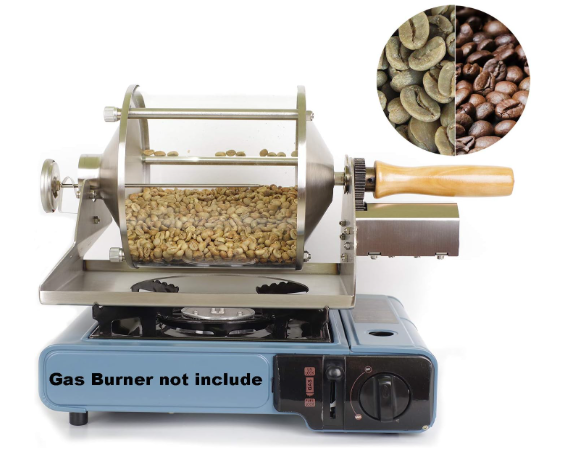
This DYVEE Coffee Roaster is a compact, transparent-drum roaster built for home use.
Its defining feature is a quartz glass drum that sits over a gas burner which is not included, where it lets you watch beans transform from green to roasted in real time rather than relying on periodic sampling.
A 12V DC motor rotates the drum for even heating, and the whole unit ships as a set with a funnel, power adapter, and manual.
This kind of gas burner coffee beans roaster is aimed at home enthusiasts who want to learn roast development visually
Particularly, it’s well suited to people just getting serious about best gas roaster for green coffee beans shopping who want to actually see first and second crack happen rather than guess from sound and smell alone.
Because it’s compact whish is 43 x 21 x 21.5cm and runs off any gas burner, this roaster also works well for smaller households or anyone without space for a larger drum roaster.
Key Points
- Fully transparent quartz glass drum.
Unlike metal-drum roasters, you get an unobstructed view of the entire roast that is genuinely useful for building an intuition around color changes and crack timing, especially for beginners. - Safe low-voltage 12V motor.
The motor runs on 12V rather than mains voltage, which reduces shock risk near an open gas flame where it is a meaningful safety consideration given the roaster’s direct-heat design. - Simple four-step operation.
Load beans, switch on the motor, turn on the burner, and monitor where there’s no programming or digital interface to learn, which keeps the roaster approachable for first-time buyers.
Pros:
- Unmatched visual monitoring thanks to the quartz glass drum
- Low-voltage motor design adds a layer of safety around an open flame
- Compact and reasonably portable at roughly 43cm long
- Simple, no-frills operation with a short learning curve for the mechanics
Cons:
- No gas burner included and you’ll need to source one separately
- No built-in thermometer, so temperature tracking relies on a separate probe or visual judgment alone
- Glass drum is more fragile than stainless steel alternatives and requires careful handling
- Motor only rotates the drum; it doesn’t automate heat control, so you’re actively managing the burner throughout
If you’re specifically comparing options as the best gas burner roaster for specialty coffee learning tool, this DYVEE’s glass drum makes it one of the more instructive home roasters available
With this roaster, you genuinely see what’s happening to the beans, which shortens the learning curve for reading roast development by eye.
It’s less suited to larger-scale use; anyone planning to scale into a gas powered coffee roaster machine for small business will outgrow its small batch size and lack of automation fairly quickly, but as an entry point for understanding roast visually, it does its job well.
Buy DYVEE Coffee Roaster Gas Burner Now
2. KALDI Wide400 Home Coffee Gas Roaster – 400g Capacity Review
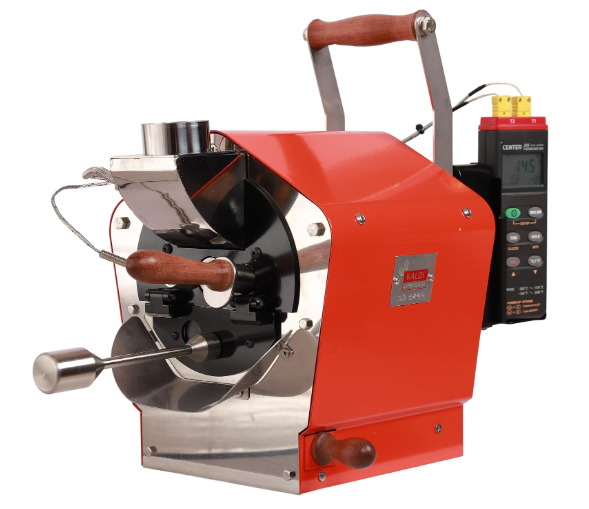
This KALDI Wide400 Home Coffee Gas Roaster – 400g Capacity is a tabletop gas coffee bean roaster built for home roasters who want more control and volume than a stovetop popcorn-style roaster can offer.
It’s a semi-convection drum roaster: green beans sit inside a SUS304 stainless steel drum, a small DC motor with 24V, 6W turns them at a steady 60 RPM, and heat comes from a gas burner placed underneath.
A heat shield and internal insulation help the roaster hold consistent temperatures with only a couple of adjustments to the burner, rather than constant fiddling.
This coffee beans roasting machine suits home coffee enthusiasts who’ve outgrown pan-roasting or a basic popper and want batch sizes that is up to 400g
This machine can produce enough roasted coffee to actually get through a week.
It’s also a reasonable fit as a propane coffee bean roaster for camping or backyard setups, since it’s compact that is 440 x 230 x 390mm
It also runs off any portable gas burner, and doesn’t need a dedicated 110V/220V heating element.
If you already own or are willing to buy a propane camp stove, this Wide400 travels well for outdoor roasting sessions.
Key Points
- Dual analog thermometers and a front sight glass.
You get real-time bean and exhaust temperature readings plus a window to watch color development that is critical for catching first and second crack without guessing. - Front-discharge design.
Beans drop out the front instead of tipping the whole unit, which makes cooling and cleanup noticeably less awkward than older top-load Kaldi models. - Optional chaff collector compatibility.
The Wide400 ships as a natural-exhaust roaster, but it can connect to KALDI’s separate chaff collector for forced airflow whiciu is also useful if smoke and chaff control matter in your roasting space.
Pros:
- Solid SUS304 stainless steel construction rated for repeated home use
- Reasonably portable at 15kg, making it viable as a propane coffee bean roaster for camping trips or patio roasting
- Front sight glass and dual thermometers give real visual and numeric feedback during the roast
- Upgradeable to digital or data-logger thermometers for Artisan software tracking
Cons:
- Gas burner is not included, so factor that into your total cost
- Natural exhaust by default means smoke and chaff need a plan such as window, vent hood, or the optional collector
- 400g batches, while bigger than entry-level roasters, still cap out well below commercial equipment
If you’re looking for the tabletop gas coffee bean roaster category and want something that doubles as a propane coffee bean roaster for camping, this KALDI Wide400 Home Coffee Gas Roaster – 400g Capacity is a genuinely versatile pick.
For roasters who eventually want to step up, KALDI’s own gas drum coffee bean roaster for home lineup extends further with the Fortis 600g capacity and Fortis Plus models, which add built-in cyclones and larger drums.
This Wide400 makes sense as an entry point: it delivers real visibility and temperature feedback in a portable, well-built package, without the higher price and larger footprint of the bigger Kaldi machines.
Buy KALDI Wide400 Home Coffee Gas Roaster – 400g Capacity Now
3. KALDI WIDE Home Coffee Gas Roaster 300g Review
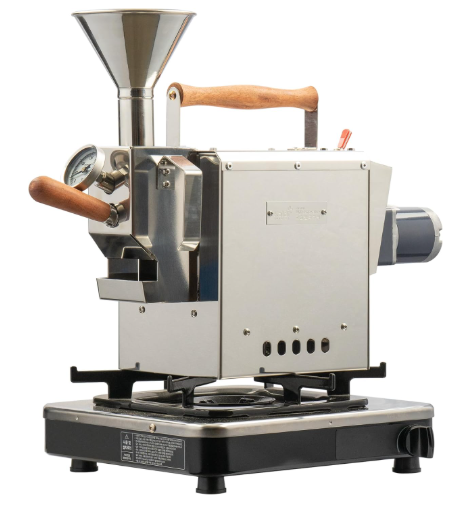
For coffee enthusiasts who want to move beyond pre-roasted beans, this KALDI WIDE Home Coffee Gas Roaster – 300g Capacity offers a hands-on approach to roasting.
Its compact capacity makes it particularly interesting for home users who want control over the roasting process without investing in a large commercial machine.
Rather than focusing on automation, this roaster is designed around direct involvement, allowing users to monitor the beans and adjust the roasting process according to their preferred profile.
This KALDI WIDE Home Coffee Gas Roaster 300g is primarily designed for small-batch coffee roasting at home.
Its approximately 300g roasting capacity provides enough room for experimentation while remaining practical for personal coffee consumption.
This type of roaster is intended for users who want to control variables such as heat, roasting time, and bean development.
Compared with highly automated countertop appliances, a manual gas roasting setup can provide a more interactive experience.
Users can observe the beans, listen for cracking stages, and make adjustments throughout the roast.
Because gas equipment requires appropriate ventilation and safe handling, buyers should also confirm the manufacturer’s fuel and installation requirements before use.
Specifically, this KALDI WIDE Home Coffee Gas Roaster – 300g Capacity is best suited to home coffee enthusiasts, aspiring home roasters, and experienced hobbyists who enjoy controlling their roast profiles.
Its 300g capacity makes it less appropriate for someone who needs to roast several kilograms at once, but it can be a practical size for regular personal use.
It is also appealing to users who want to learn how roast development works rather than relying entirely on preset programs.
Key Points
- 300g Small-Batch Capacity
The 300g capacity strikes a useful balance between experimentation and productivity.
You can roast enough beans for multiple brewing sessions while keeping individual batches manageable.
This is particularly useful when testing different origins, roast levels, or roasting techniques. - Gas-Powered Roasting
Gas heat gives experienced users direct control over the roasting process.
Instead of depending entirely on fixed electric heating cycles, the operator can adjust the heat source during roasting.
This hands-on approach can be valuable for developing consistent roast profiles. - Manual Monitoring and Control
This KALDI WIDE Home Coffee Gas Roaster – 300g Capacity is designed for active roasting rather than complete automation.
A gas coffee bean roaster with thermometer can be especially useful because monitoring temperature helps the user understand how the roast progresses and when adjustments may be necessary.
Pros
- Practical 300g capacity for home roasting
- Hands-on control over the roasting process
- Gas heating provides responsive heat management
- Suitable for experimenting with roast profiles
- Compact alternative to larger commercial roasters
Cons
- Requires active monitoring
- Not designed for high-volume commercial roasting
- Gas operation requires appropriate ventilation and safety precautions
- Less convenient than an automatic gas coffee bean roaster machine
- Beginners may need some practice to achieve consistent results
This KALDI WIDE Home Coffee Gas Roaster 300g is a compelling choice for coffee enthusiasts who value control, experimentation, and small-batch roasting.
Its manageable capacity and gas-powered design make it more engaging than a fully automated appliance, while the ability to monitor temperature and adjust the roast gives experienced users plenty of room to refine their technique.
However, for those who are looking for push-button convenience, they may prefer an automatic model.
For beginners willing to learn the fundamentals of gas roasting, this machine can serve as a capable gas burner coffee bean roaster for them, especially when the priority is learning how heat, timing, and bean development work together.
Buy KALDI WIDE Home Coffee Gas Roaster – 300g Capacity Now
4. ICZW Coffee Bean Roaster 14.5L Review
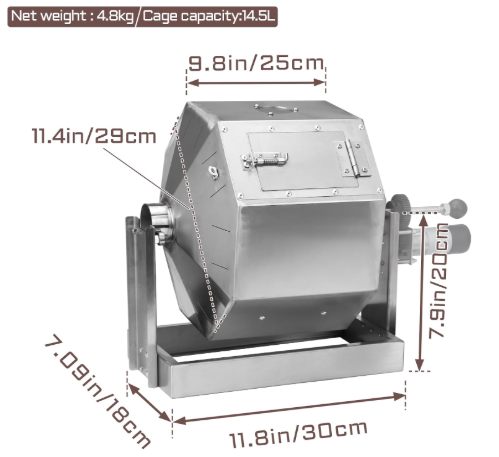
For coffee enthusiasts moving toward larger-scale roasting, the ICZW Coffee Bean Roaster 14.5L is designed to provide substantially more capacity than compact home roasters.
Its larger drum and gas-roasting format make it worth considering for users who need to roast more beans per session while maintaining hands-on control over the roasting process.
This ICZW Coffee Bean Roaster 14.5L is primarily intended for higher-volume coffee roasting, making it more suitable for small commercial operations, serious hobbyists, cafés, and micro-roasting environments than casual home use.
A larger-capacity roaster can reduce the number of batches required to prepare coffee, which may improve workflow for users roasting regularly.
The gas-heated format also allows the operator to actively manage the roasting process rather than relying entirely on preset electric programs.
However, you should confirm the exact usable bean capacity, burner requirements, dimensions, ventilation needs, and installation specifications before purchase.
A 14.5L drum volume should not automatically be interpreted as a 14.5L bean capacity.
This ICZW Coffee Bean Roaster 14.5L is best suited to small coffee businesses, cafés, aspiring micro-roasters, and experienced home roasters who need more capacity than a typical countertop machine provides.
This ICZW Coffee Bean Roaster 14.5L can be particularly attractive to someone establishing a small roasting operation and looking for a machine that offers a more substantial production workflow.
For occasional home roasting, however, its larger footprint and gas requirements may be unnecessary.
Key Points
- Large 14.5L Roasting Chamber
The spacious 14.5L design is the main attraction.
A larger roasting chamber can support higher-volume production and reduce the need to repeatedly roast small batches.
For a gas coffee bean roaster for small coffee shop applications, that potential productivity can be a significant advantage.
The important consideration is the manufacturer’s recommended green-bean capacity rather than chamber volume alone. - Gas-Powered Heating
Gas heating provides hands-on control over the roasting environment.
Experienced operators can adjust heat as the beans progress through drying, browning, and development stages.
This makes the machine particularly interesting as a gas coffee roaster for micro roastery operations where roast profiling and repeatability are important. - Designed for More Demanding Roasting Work
Compared with small home machines, a larger-format roaster is better positioned for users who roast frequently.
More capacity can make it easier to prepare coffee for customers, events, subscriptions, or multiple daily brewing requirements.
Nevertheless, larger machines also demand more attention to ventilation, fuel connections, operating space, and safety procedures.
Pros
- Large 14.5L chamber
- Suitable for higher-volume roasting
- Gas heating enables hands-on heat management
- Potentially useful for small commercial operations
- More productive than compact home roasters
Cons
- May be excessive for casual home users
- Requires appropriate ventilation and gas setup
- Larger footprint than countertop roasters
- Requires operator involvement and roasting experience
- Actual bean capacity should be verified before purchase
This ICZW Coffee Bean Roaster 14.5L is best viewed as a capacity-focused gas roasting machine rather than a simple home appliance.
Its larger chamber and gas-heating format can appeal to cafés, serious roasting enthusiasts, and developing micro-roasteries that need greater production potential.
For those who are searching for a commercial gas coffee bean roaster for small business, this roasting machine deserves consideration if its actual batch capacity, installation requirements, and operating specifications match the intended workload.
Its biggest advantage is the potential to roast larger quantities more efficiently, while its main drawbacks are the additional space, setup, ventilation, and operator expertise required.
Overall, it makes the most sense for users ready to move beyond small-batch hobby roasting and toward a more structured coffee-roasting workflow.
Buy ICZW Coffee Bean Roaster 14.5L Now
5. Kaldi Fortis Coffee Roaster with Accessories – 600g, Direct Flame Review
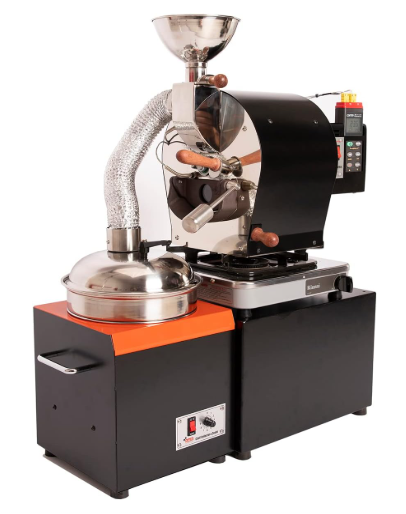
This Kaldi Fortis Coffee Roaster with Accessories – 600g Capacity version is built around direct-flame roasting where the drum sits over an open gas flame rather than behind a heat shield, giving a more traditional, hands-on style of roasting.
It’s a gas coffee roaster with propane burner setups in mind, requiring at least 8,000 BTU of burner output to run properly, and roasts up to 600g of green coffee per batch.
This Kaldi Fortis Coffee Roaster with Accessories – 600g Capacity is suitable for home roasters who specifically want direct-flame character in their roasts and are comfortable managing a more reactive heat source.
It’s also a strong option for coffee lovers searching for a coffee bean roaster for LPG burner use, since propane/LPG burners are the most common heat source paired with this style of roaster which no natural gas line or dedicated electric heating element required.
Key Points
- Direct-flame drum with dual temperature sensors.
Two sensors track both bean temperature and exhaust temperature, giving you real feedback despite the more volatile heat source compared to semi-convective models. - Front lever discharge and viewing window.
You can watch roast progress through the trier and viewing window, then release beans via a front lever rather than tipping the unit that is practical when you’re also managing burner adjustments in real time. - Artisan-compatible thermometer upgrade.
The default digital thermometer can be upgraded to a data-logger version for logging roast curves in Artisan software, useful if you want to replicate direct-flame roasts consistently.
Pros:
- Direct-flame heating gives more immediate, responsive control over roast development
- Dual bean/exhaust thermometers provide real data despite the more reactive heat source
- Front-lever discharge and viewing window make monitoring and unloading straightforward
- 600g capacity handles serious home-roasting volume in one batch
Cons:
- Requires a burner rated at 8,000+ BTU and many small camping stoves won’t cut it
- Direct flame demands more attentiveness than semi-convective roasting; scorching is easier if you’re inexperienced
- No burner included, so total setup cost extends beyond the roaster’s sticker price
- Heavier and less portable than smaller Kaldi models at roughly 15kg
For coffee lovers looking for the character of a genuine direct flame gas coffee bean roaster, this Kaldi Fortis Coffee Roaster with Accessories, 600g Batch variant delivers real control at a meaningful 600g batch size.
Pairing it with a proper propane or LPG burner gives you a responsive, traditional roasting setup with enough thermometer feedback to actually track what’s happening inside the drum
You can just go in expecting a steeper learning curve than semi-convective alternatives, and budget for the burner separately.
Buy Kaldi Fortis Coffee Roaster with Accessories, 600g Batch Now
Conclusion
Choosing a gas coffee bean roaster is less about finding one universally “best” machine and more about matching capacity, control, construction, and operating style to your roasting goals.
KALDI Wide400 Home Coffee Gas Roaster 400g Capacity, Kaldi Fortis Coffee Roaster with Accessories 600g Batch, KALDI WIDE Home Coffee Gas Roaster 300g, ICZW Coffee Bean Roaster 14.5L, and DYVEE Coffee Roaster Gas Burner occupy different positions, from compact hobby machines to larger-capacity roasting equipment.
Design
- KALDI lineup shares a family resemblance: SUS304 stainless steel gas coffee bean roaster construction, front-discharge hatches, and sight glasses for watching the roast.
KALDI Wide400 and WIDE 300g are the most compact of the three, while KALDI Fortis 600g adds a motor-cooling fan which is paired with KALDI’s optional accessory, a gas coffee roaster with cooling tray for proper post-roast cooldown.
KALDI Wide400 offers a compact format with a 400g capacity, making it a practical middle ground for home roasters who want more capacity than a very small machine
KALDI WIDE 300g is even more focused on home use and small batches, while the Kaldi Fortis 600g steps up capacity for users who roast more frequently. - ICZW 14.5L is the largest-format option in this group. Its substantial chamber makes it more appropriate for higher-volume applications, although buyers should distinguish chamber volume from actual recommended bean capacity.
ICZW 14.5L takes a different approach entirely: it’s a large stovetop drum with V- and T-shaped baffles, built for volume rather than refinement. - DYVEE stands apart visually with its quartz glass drum, making it the only one where you can watch beans roast with zero obstruction
Though that glass is also the most fragile component in this lineup.
DYVEE Coffee Roaster Gas Burner is better suited to buyers interested in a flexible gas-roasting setup rather than simply choosing the largest drum. Depending on the configuration, this style can appeal to DIY-oriented users.
For those specifically seeking a stainless steel gas coffee bean roaster, construction details should be checked carefully against the manufacturer’s specifications rather than assumed from product naming.
Performance
- For anyone prioritizing a gas coffee roaster with temperature control, KALDI Fortis and Wide400 lead the pack with dual analog or digital thermometers tracking bean and exhaust temperature, both upgradeable to Artisan-compatible data loggers.
- KALDI Fortis’s direct-flame variant qualifies as a genuine direct flame gas coffee bean roaster, giving more responsive, traditional heat control at the cost of a steeper learning curve.
- KALDI WIDE 300g performs well as a mini gas burner coffee bean roaster for home hobbyist use, trading batch size for a gentler entry point.
Gas roasting provides direct heat adjustment, which is valuable for developing roast profiles. - KALDI models are particularly suited to hands-on home roasting because their smaller capacities allow users to experiment without committing large quantities of beans.
- Kaldi 600g Fortis has an advantage for users who want to roast more coffee per session while maintaining manual control.
- ICZW wins on raw batch capacity 2.5–3kg but lacks a built-in thermometer, so it functions more like a manual gas burner coffee roaster with thermometer only if you add your own probe.
Meanwhile, ICZW model is potentially the strongest choice for volume-oriented roasting. - DYVEE, with no digital feedback at all, demands the most experience-based judgment of the group.
A gas coffee roaster with temperature control can make repeatability easier, but experienced operators can also learn to manage heat through observation, timing, and temperature monitoring.
A gas coffee roaster with cooling tray can be convenient after the roast because rapid cooling helps stop further bean development.
You should verify whether a cooling system is included rather than assuming it is.
Ease of Use
- KALDI WIDE 300g is arguably the least intimidating option for someone learning the fundamentals of gas roasting. Its smaller batch size makes experimentation relatively manageable.
- KALDI WIDE 300g is the easiest starting point, essentially functioning as a DIY gas burner coffee bean roaster kit with motor, hopper, sampler, and chaff holder all included.
- KALDI Wide400 and Fortis are similarly beginner-friendly thanks to sight glasses and thermometers, just with bigger batches to manage.
- KALDI Wide400 and Fortis 600g require more attention as capacity increases. A manual gas burner coffee roaster with thermometer can be rewarding for users who enjoy controlling each stage of the roast, but it is not as effortless as an automatic roaster.
- DYVEE may appeal to mechanically inclined buyers looking for a DIY gas burner coffee bean roaster kit approach.
- DYVEE sits in between: mechanically simple, but visually intensive since you’re reading the roast entirely by eye.
- ICZW is better suited to operators already comfortable with gas roasting equipment.
- ICZW is the most physically demanding with its size and lack of instrumentation reward experience over convenience.
The Winner
- Best overall for home hobbyists: KALDI Wide400.
Its 400g capacity offers a useful compromise between batch size and manageable home operation.
It can function as a mini gas burner coffee bean roaster for home hobbyist use without moving into the larger footprint of commercial-style equipment. - Best for larger home batches: Kaldi Fortis 600g.
Choose it if 400g is limiting and you want more roasting capacity. - Best for smaller experiments: KALDI WIDE 300g.
It suits beginners and hobbyists prioritizing manageable batches. - Best for higher-volume roasting: ICZW 14.5L.
Its larger format is more appropriate for serious production environments. - Best for DIY-oriented users: DYVEE.
It may be attractive to buyers who enjoy hands-on equipment and direct-flame roasting.
Beginners wanting a low-cost, low-risk entry point should start with the KALDI WIDE 300g.
Home enthusiasts who want serious thermometer feedback and room to grow should choose the KALDI Wide400 or step up to the Fortis 600g for larger batches and direct-flame character.
Small commercial operators roasting in bulk should look at the ICZW 14.5L, accepting the tradeoff of manual temperature tracking.
Visual learners who want to watch every second of the roast will get the most value from the DYVEE, provided they’re comfortable without built-in temperature readings.
Ultimately, a direct flame gas coffee bean roaster rewards active involvement. The best choice depends on whether you prioritize compact home use, larger batches, production capacity, or hands-on customization.
And, there’s no single best gas burner coffee beans roaster here but only the best fit for your batch size and experience level.
