
Fix Cuisinart Coffee Maker: 6 Easy Troubleshooting Tips
When your Cuisinart coffee maker stops working, it can be frustrating, especially when you are ready for your morning coffee. Fortunately, not every problem means your machine is broken. A loose water reservoir, clogged needle, unresponsive control system, or dirty brewing components may be responsible.
Whether your Cuisinart coffee machine won’t brew, won’t power on, or acts strangely, the good news is that most problems have simple fixes.
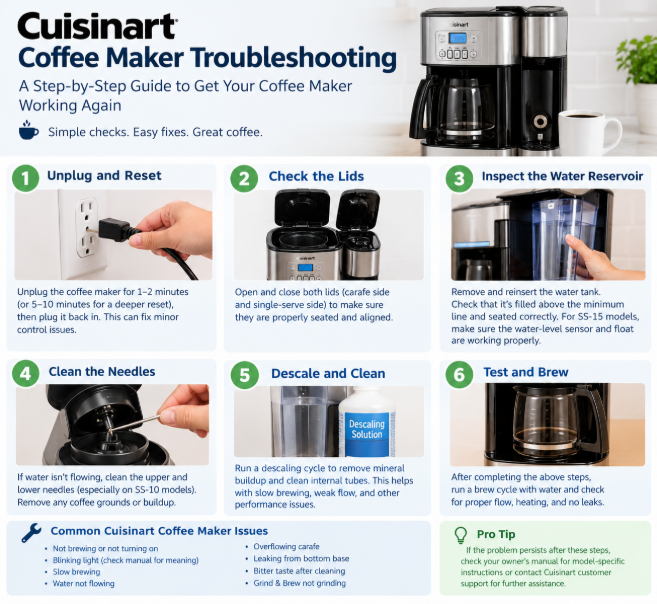
This guide walks you through the most practical fix Cuisinart coffee maker troubleshooting with 6 simple fixing steps
It also covers common issues with the Cuisinart Coffee Center SS-15, SS-10 single-serve models, and Grind & Brew machines. Start with the easiest solutions of how to fix no-brew, clogged needles, water flow problems, blinking lights, sensor faults, and cleaning
Start Here: 6 Quick Fixes When Your Cuisinart Coffee Maker Isn’t Working
Cuisinart coffee maker “Not working” error can mean many things: no brewing, no power, or one side of a dual machine failing.
These six checks cover the most common causes and cost nothing to try. If you are searching the solution for how to fix Cuisinart coffee maker not brewing, begin with this list.
1. Unplug the Coffee Maker to Reset It
If your coffee maker suddenly stops responding, unplugging it is one of the simplest troubleshooting steps to try. A temporary control-system issue may prevent the machine from starting a brew cycle or responding to button presses.
How to Perform a Basic Reset Practically
- Turn off the coffee maker if the controls are responsive.
- Unplug the machine from the electrical outlet.
- Wait one or two minutes. For a longer reset attempt, leave it unplugged for five to ten minutes.
- Reconnect the machine and check whether the controls work normally.
- Try a brew cycle with water, following the instructions in your owner’s manual.
In simple words, unplug the coffee maker for one to two minutes, then plug it back in. This acts as a mini reset. For a deeper reset, leave it unplugged for five to ten minutes. This step takes almost no effort and often clears simple electronic glitches.
If you are searching a solution for a cuisinart coffee maker won’t turn on fix, check the outlet and power connection before assuming the appliance has failed.
This basic reset may help with temporary glitches, but it will not repair a failed pump, damaged wiring, or defective sensor.
Check the Power Outlet
Test the exact outlet you are using with a working lamp or phone charger. If you have a double outlet, check the same socket rather than assuming both connections are functioning. Avoid using a damaged outlet or an extension cord that is not rated for the appliance.
2. Open and Close Both Lids Properly
The Cuisinart Coffee Center SS-15 combines a full-pot coffee maker with a single-serve brewer. If one side stops working, check that its lid and brewing compartment are properly closed.
On a dual machine, open and close the lid on the carafe side and the lid on the single-serve side. A lid that isn’t fully seated can stop the machine from starting a cycle. It takes a few seconds and sometimes solves the problem on the spot.
What to Check
- Open and close the single-serve lid securely.
- Check that the carafe-brewing side is positioned correctly for a full-pot brew.
- Make sure the pod holder and removable components are seated properly.
- Remove any obstruction that prevents a lid from closing normally.
Do not force a lid shut. If it will not close easily, inspect the pod holder, basket, or other removable parts for incorrect positioning. A lid or component that does not engage correctly may prevent brewing.
3. Check the Water Reservoir and Water-Level Sensor
A coffee maker cannot brew normally if it cannot draw enough water. Check the reservoir before investigating more complicated problems.
On the single-serve side, a removable water tank sits at the back. Lift off the lid, use the handle to pull the tank out, and set it back firmly.
A poorly seated tank is a frequent reason for a Cuisinart coffee maker water not flowing complaint, because the tank may not connect properly with the intake
Fix Cuisinart Coffee Maker SS-15 Water Level Sensor & Clean Light Problems
The SS-15 pairs a full-pot side with a single-serve side. A known issue appears when the single-serve side shows a low-water light even though the tank is full. To fix Cuisinart coffee maker SS-15 water level sensor problems, it helps to understand how the sensor works
How the Sensor Works
The back of the reservoir has a minimum fill mark. Inside, a hollow black plastic disc containing a magnet floats upward as the tank fills. When you seat the reservoir, the magnet lines up with a sensor in the unit, which switches off the low-water light.
What Goes Wrong
In the machine shown in the tutorial, the hollow disc had filled with water. The extra weight kept it from floating, so the sensor never saw the magnet. Cutting the disc open confirmed a magnet inside, and a screwdriver held near it can move the disc up and down.
The Solution
The disc is mounted on a post that is hard to remove without breaking, so the reliable solution is to replace the water reservoir. After doing so, the single-serve side worked normally again.
Clean Light Stuck On
Owners also search for a Cuisinart SS-15 clean light won’t turn off reset fix. Start with a full power reset by unplugging for ten minutes, then run a descaling cycle with vinegar followed by clean-water rinses. If the light persists, check the reservoir and sensor as described above.
One reported SS-15 problem occurs when the single-serve side displays a low-water warning even though the reservoir is full. The water-level mechanism uses a floating plastic disc containing a magnet. When the float rises with the water level, the machine’s sensor detects the magnet and recognizes that sufficient water is available.
If the hollow float fills with water, it may become too heavy to rise. The machine can then continue displaying a low-water warning even when the reservoir contains plenty of water.
Steps to Try
- Confirm that the reservoir is filled above its minimum water line.
- Remove the reservoir if your model has a removable tank.
- Reinstall it firmly and make sure it sits correctly in its holder.
- Check for visible damage or a float that appears stuck, if it can be inspected without disassembly.
- Retry the single-serve brewing function.
If the warning persists, the reservoir float or internal sensor may be faulty. In the reported SS-15 example, replacing the water reservoir resolved the problem. Confirm the correct replacement part for your model before purchasing one.
What If the Cuisinart Coffee Maker Water Is Not Flowing?
If your cuisinart coffee maker water not flowing problem continues after checking the reservoir, possible causes include clogged needles, mineral deposits, or an internal water-delivery fault. Start with the removable components and cleaning procedures before assuming the pump has failed.
4. Clean the Coffee Maker and Unclog the Needles
Cleaning is one of the most useful troubleshooting steps because coffee residue and mineral buildup can interfere with normal operation. If your cuisinart coffee maker clogged how to unclog search has led you here, begin by inspecting the removable brewing components.
How to Clean the Needles on a Cuisinart SS-10
Cuisinart coffee maker with Clogged K-Cup needles are a very common cause, and the fix is a paper clip. This is the core of Cuisinart SS-10 troubleshooting single serve not pumping, and it answers how to clean needle Cuisinart SS-10 not working.
The Cuisinart SS-10 single-serve brewer has an upper needle and a lower needle. Coffee grounds can accumulate around these openings and restrict water flow. A blocked needle can make the machine appear broken even when the pump is still functioning.
Step-by-Step Needle Cleaning
- Disconnect the power. Turn off and unplug the coffee maker. Allow hot components to cool before handling them.
- Remove the lower basket. Follow the manual to release the removable pod-holder assembly. Handle the exposed needle carefully because its point is sharp.
- Separate the removable parts. If the holder is designed to come apart, clean the pieces with warm water, mild dish soap, and a small brush.
- Clear the lower needle. Use a suitable cleaning tool, such as a straightened paper clip only if the manufacturer’s instructions permit it. Gently remove visible debris without forcing the tool.
- Inspect the upper needle. Carefully clear visible residue without pushing the tool too far into the assembly or damaging any internal tubing.
- Rinse and reassemble. Rinse removable parts thoroughly, reinstall them according to the alignment markings, and ensure everything sits flush.
- Run a water-only rinse. With no coffee pod installed, use the machine’s rinse function if available. Keep a suitable mug underneath and avoid contact with hot water.
These steps explain how to clean needle Cuisinart SS-10 not working situations without immediately replacing the machine. If the needle assembly is damaged or cannot be removed as described, consult the manual rather than forcing it apart.
How to Clean the Bottom Needle
- Turn the machine off and unplug it.
- Remove the K-Cup basket by poking up from the bottom and squeezing the sides. Be careful, because the needle is sharp.
- Separate the basket halves. Small tangs hold them together, so a firm pull releases them.
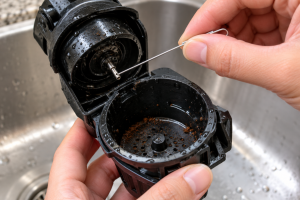
- Run a paper clip through the needle opening. Unlike some competing brewers, you can see the clip pass all the way through.
- Rinse the part under running water to flush out impacted grounds, and wash the basket with soap, water and a brush.
- Line up the two small ears with their holes and snap the halves together. When it won’t turn or come apart easily, it is secured.
- Reinstall the basket, align the arrows, and confirm it sits flush so the lid closes without friction.
How to Clean the Top Needle
The top needle is more open and connects to a tube on the other end. Insert the paper clip at an angle, move it in a circle, and do not push too far or force it, or you could puncture the tube.
Flush the System
Remove any K-Cup, place a mug underneath, and run several rinse cycles or large brews. Be careful, since the water comes out hot. You may need to repeat the process before the clog fully clears.
How to Unblock Cuisinart Coffee Maker Internal Tubes
If cleaning the needles does not restore water flow, mineral deposits or residue may be restricting the internal water passages. Follow the manufacturer’s descaling instructions and use a compatible descaling solution. Run the prescribed cleaning cycle and rinse thoroughly with fresh water afterward.
This is the safer starting point for learning how to unblock Cuisinart coffee maker internal tubes. Avoid opening the machine’s housing or inserting tools deep into internal passages. Internal tubing, electrical connections, and heating components are not intended for casual probing.
Descale the Machine Correctly
Some Cuisinart models have a Clean button or a dedicated descaling procedure. Others require a different sequence. Check the instructions for your specific model before using vinegar, detergent, or a commercial descaler. Never mix cleaning chemicals, and do not run dish detergent through the brewing system unless the manufacturer explicitly directs you to do so.
5. Troubleshoot Common Brewing Symptoms
If the basic reset, reservoir checks, and cleaning steps do not solve the issue, identify the symptom more precisely. Different problems require different solutions.
The main causes of Cuisinart coffee maker not brewing come up repeatedly: water reservoir issues, a clogged machine, and a system malfunction.
a. Check the Water Reservoir
With no water, the machine can’t brew. Make sure the reservoir has enough water and is positioned correctly. This simple check is the first answer to how to fix Cuisinart coffee maker not brewing.
b. Clean a Clogged Coffee Maker
For a Cuisinart coffee maker clogged how to unclog routine, pour a mix of water and vinegar into the reservoir, then run a brew cycle or press the clean button if your model has one. Flush again with water and a little detergent, then run plain hot water through several times to rinse.
c. Unblocking Internal Tubes
Persistent clogs may sit deeper in the machine. Learning how to unblock Cuisinart coffee maker internal tubes usually starts with repeated hot-water flushes. Run several full cycles so the water can push scale and grounds through. If flow stays weak afterward, consult your manual or a service professional rather than forcing anything.
Cuisinart Coffee Maker Power Light Blinking Won’t Brew Fix
A blinking indicator can mean different things depending on the model and the selected function. For a cuisinart coffee maker blinking light meaning search, check the owner’s manual for the specific light pattern. Confirm that the reservoir contains enough water, the lid is closed, and the brewing components are correctly installed. Reset the machine if appropriate.
Do not assume every blinking light indicates the same fault. A warning that remains after these checks may require model-specific troubleshooting.
How to Fix Cuisinart Coffee Maker Not Brewing
When a brew cycle will not start, work through the following checklist:
- Confirm that the machine has power.
- Check that the reservoir is filled and positioned correctly.
- Ensure the lid is closed and the basket or pod holder is installed.
- Inspect and clean accessible needle openings.
- Descale the machine if mineral buildup is suspected.
- Unplug the machine briefly and retry the brew cycle.
These checks address common reasons behind how to fix cuisinart coffee maker not brewing without immediately replacing components.
Cuisinart SS-10 Troubleshooting: Single Serve Not Pumping
If the SS-10 makes noise but does not dispense water, first verify the water level and clean the needle assembly. If the machine remains silent or cannot move water after cleaning and descaling, the pump or another internal component may need professional inspection.
Cuisinart SS-15 Clean Light Won’t Turn Off Reset Fix
If the Clean light remains on after cleaning, follow the reset or descaling completion procedure in the SS-15 manual. Check that the cleaning cycle has completed and that the required rinse steps have been performed. A power reset may help with a temporary control issue, but a persistent warning can indicate that the cleaning cycle needs to be repeated or that servicing is necessary.
Cuisinart Coffee Maker Slow Brewing Troubleshooting
Slow brewing can result from mineral scale, restricted needle openings, or accumulated coffee residue. Clean removable parts and descale the machine as directed. If brewing remains unusually slow, do not repeatedly force additional cycles through a machine that appears blocked.
Fix Cuisinart Coffee Maker Heating Element Not Working
If the machine powers on but does not heat water, a heating-system fault may be responsible. However, a cold or incomplete brew can also result from water-flow problems. Check the reservoir, cleaning status, and normal operating settings first. Do not open the housing to test the heating element yourself; internal electrical and heating repairs should be handled by a qualified technician.
Cuisinart Coffee Maker Leaking Water From Bottom Base Repair
Unplug the machine if you notice water leaking from its base. Empty the reservoir, dry the surrounding area, and inspect removable tanks and accessible seals for visible damage. If water continues leaking from the internal base, stop using the machine until it has been inspected. Do not operate an appliance with water near electrical components.
How to Fix Cuisinart Coffee Maker Overflow Problem
An overflowing brew basket may result from an incorrectly seated filter, excessive coffee grounds, an unsuitable filter, or a clogged outlet. Check the recommended coffee quantity, make sure the filter is properly positioned, and clean the basket and accessible drainage areas.
For a cuisinart coffee maker overflowing carafe fix, also check that the carafe is correctly placed and that the brew basket’s drip-stop mechanism is not obstructed. Never exceed the machine’s recommended fill level.
6. Troubleshoot Cuisinart Grind & Brew Models
Grind & Brew machines combine grinding and brewing, so coffee grounds can obstruct the chute or filter area. Before cleaning, unplug the machine and allow moving parts to stop completely.
Cuisinart Grind and Brew Clog Repair Guide
Remove the removable grinder components as instructed in the manual. Brush away dry coffee grounds and residue, then check that the chute and filter basket are free of obstructions. Keep electrical components dry and reinstall every part correctly before use.
Cuisinart DGB-900BC Chute Overflow Fix
If your DGB-900BC experiences chute overflow, inspect the grinding chute for compacted grounds and confirm that the filter basket is installed correctly. Use a dry brush for loose residue where the manual permits. Avoid pouring water into the grinder housing or forcing tools through the chute.
Cuisinart Grind and Brew Not Grinding Fix
If the grinder does not operate, disconnect the power before inspecting removable parts. Check for trapped grounds, an improperly seated component, or an overloaded grinder. If the grinder remains inoperative after cleaning and reassembly, the motor, switch, or another internal component may require service.
Additional Problems Worth Checking
How to Replace Cuisinart Coffee Maker Check Valve
A faulty check valve can contribute to water-delivery problems, but the symptoms may overlap with pump, scale, or tubing issues. Confirm the diagnosis before buying parts. Replacing a valve generally requires access to internal plumbing, so use a model-specific service procedure or consult a qualified repair technician rather than opening the appliance without proper knowledge.
Cuisinart Coffee Maker Carafe Won’t Pour Without Dripping
If the carafe drips while pouring, inspect the spout for dried coffee residue and check for damage. Clean the carafe according to its care instructions and avoid pouring too quickly. Replace a cracked or damaged carafe rather than continuing to use it.
Cuisinart Coffee Maker Bitter Taste After Cleaning
A bitter taste after cleaning may come from residual cleaning solution, old coffee oils, or stale grounds. Run the recommended fresh-water rinse cycles and wash removable coffee-contact parts thoroughly. If the taste persists, inspect the filter basket and grinder for residue and follow the manufacturer’s cleaning guidance.
Water Leaks and Overflow Solution
- Leaking: For a Cuisinart coffee maker leaking water from bottom base repair, unplug the unit and check the reservoir seating, cracks, and loose hoses before use.
- Overflow: To learn how to fix Cuisinart coffee maker overflow problem, check that the basket and filter are seated and that the grounds aren’t clogging the drain. This also applies to a Cuisinart coffee maker overflowing carafe fix.
- Dripping carafe: A Cuisinart coffee maker carafe won’t pour without dripping issue is usually the lid or spout needing a clean or reseat.
Frequently Asked Questions
Why is my Cuisinart coffee maker not brewing?
Common causes include an empty or incorrectly positioned reservoir, clogged needles, mineral buildup, a lid that is not closed properly, or a temporary control issue. Start with these simple checks before considering internal repairs.
Why does my Cuisinart SS-15 say there is no water when the tank is full?
The reservoir’s magnetic float may be stuck or unable to rise, or the sensor may be faulty. Reposition the reservoir and inspect the float for visible problems. A damaged float assembly may require reservoir replacement.
Can I use a paper clip to clean Cuisinart coffee maker needles?
Some needle-cleaning procedures permit a paper clip, but the tool must be used gently and only when appropriate for the model. Unplug the machine first, avoid damaging the upper needle’s tubing, and never force the tool into an opening.
How often should I descale my Cuisinart coffee maker?
Follow the schedule in your owner’s manual. Descaling frequency depends on the model, water hardness, and frequency of use. A persistent cleaning indicator or reduced water flow may signal that maintenance is needed.
When should I stop troubleshooting and call a technician?
Stop if the machine leaks from its base, smells burnt, has damaged wiring, repeatedly trips an electrical breaker, or requires internal electrical or heating repairs. Persistent pump, valve, or sensor faults may also need professional diagnosis.
Why is my Cuisinart coffee maker not brewing?
The most common causes are an empty or misplaced water reservoir, clogs, or a system glitch. Check the water, clean with vinegar, and reset by unplugging.
How long should I unplug my coffee maker to reset it?
One to two minutes works for a mini reset. For a deeper reset, wait five to ten minutes.
How do I fix the single-serve side when no water comes out?
Clean both needles with a paper clip, rinse the basket, and run several water flushes.
Why does my SS-15 say low water when the tank is full?
The magnetic float disc in the reservoir may have taken on water and stopped floating. Replacing the reservoir fixes it.
Is the outlet really worth checking?
Yes. Test the exact socket with another device, because halves of one outlet can be on different circuits.
When should I call a professional?
Seek help for heating, electrical, or internal valve problems, or when the quick fixes don’t work.
Conclusion: Get Your Cuisinart Coffee Maker Working Again
Most coffee maker problems come down to power, water, clogs, or a quick reset. Work through the easy fixes first, clean the machine, and treat model-specific issues, like the SS-10 needles and SS-15 sensor, with the targeted steps above.
When your Cuisinart coffee maker stops working, begin with the six basic fixes: unplug and reset the machine, open and close the lids, reseat the water reservoir, test the outlet, inspect the appliance, and clean it properly. These simple steps can resolve several common problems without expensive repairs.
If the machine still will not brew, focus on the exact symptom. Clean clogged needles, check the SS-15 water-level float, descale restricted water passages, or inspect the Grind & Brew chute according to the manufacturer’s instructions. Persistent leaks and internal electrical, heating, pump, or valve faults require more careful diagnosis.
Key Takeaways
-
- Start with a basic power reset and check the exact electrical outlet.
- Make sure the reservoir is filled and seated correctly.
- Clean accessible needles and removable brewing parts carefully.
- Use the correct descaling procedure for your specific model.
- Verify the cause before replacing sensors, valves, pumps, or other parts.
- Stop using the machine if it leaks internally or shows signs of electrical damage.
- Unplug the machine for 1-10 minutes to reset it.
- Open and close both lids and reseat the water tank.
- Test the exact outlet with another device.
- Clean clogs with vinegar and water, then rinse thoroughly.
- Use a paper clip to clear clogged SS-10 needles, without forcing the top needle.
- Replace the SS-15 water reservoir if the float disc is waterlogged.
- Leave heating and valve repairs to a qualified technician.
With a systematic approach, you can identify many common Cuisinart coffee maker problems and determine whether a simple cleaning, replacement part, or professional repair is the most sensible next step.
Safety note: always unplug your coffee maker before cleaning or inspecting internal parts.
