
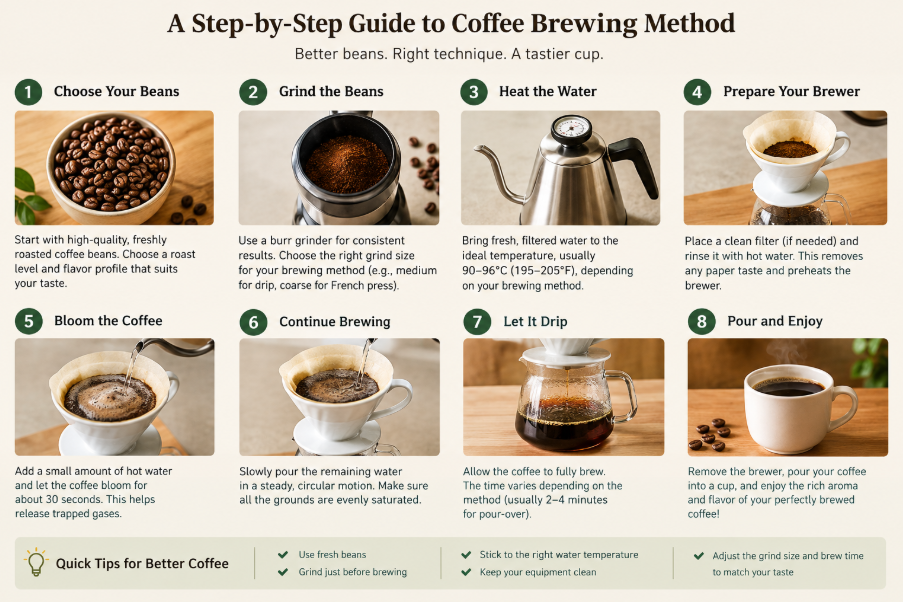
The Ultimate Coffee Brewing Method: 24 Ways to Make Better Coffee
Every coffee brewing method starts with two basic ingredients: ground roasted coffee beans and water. Yet the final cup can taste remarkably different depending on how those ingredients come together which involves temperature, pressure, time, and filtration.
One method produces a concentrated espresso with golden crema, while another creates a clean, tea-like cup with delicate floral notes. Some techniques emphasize body and bitterness, while others highlight sweetness, aroma, and acidity.
Across centuries, coffee enthusiasts have developed ingenious ways to extract flavor from the same plant. From traditional Turkish coffee and Vietnamese phin brewing to modern capsule machines, every method reflects a different combination of engineering, culture, convenience, and personal preference.
This guide explores 24 coffee brewing methods, explains how they work, and helps you choose the right brewing method for your coffee taste, budget, and lifestyle.
Why Every Coffee Brewing Method Tastes Different
Coffee is shaped by six controls: ratio, grind size, time, temperature, pressure, and filtration. Change any one of them and the same bean reveals a different face. The same Ethiopian coffee brewed in a V60 and in a moka pot becomes two entirely different drinks.
The Six Brewing Controls
- Ratio: the balance of coffee to water. A concentrated cup is not automatically a better-extracted one.
- Grind: finer particles extract quickly and can block flow, while coarse particles leave larger paths for water.
- Time: longer contact means more opportunity for extraction.
- Temperature: hotter water generally extracts faster.
- Pressure: it can come from a pump, a hand, or steam.
- Filtration: paper gives clarity, metal adds body, and no filter leaves sediment.
How Does a Coffee Brewing Method Affect Flavor?
A coffee brewing method determines how water interacts with ground coffee, how long extraction lasts, and which compounds enter the finished drink. These variables influence flavor, aroma, strength, texture, and caffeine concentration.
- Pressure: Espresso machines force hot water through finely ground coffee to produce a concentrated drink.
- Immersion: French press and cold brew allow coffee grounds to remain submerged in water during extraction.
- Gravity: Pour-over drippers and drip machines move water through coffee grounds and a filter.
- Filtration: Paper, metal, and cloth filters retain different amounts of oils and fine particles.
- Temperature and time: Hotter water generally extracts soluble compounds faster, while cold brewing relies on a much longer steep.
Understanding these brewing factors makes it easier to experiment with coffee brewing tips instead of assuming that expensive equipment automatically produces better coffee.
24 Coffee Brewing Methods Explained
1. Espresso
Espresso uses pressure to force hot water through finely ground coffee, typically producing a small, concentrated serving in approximately 25–30 seconds. A common starting recipe is 18 g of coffee in and 36 g of liquid out.
A single shot has more caffeine per milliliter than any other method, but a full mug of filter coffee often delivers more total caffeine
Modern espresso brewing commonly targets around nine bars of pressure, although the ideal extraction depends on the machine, coffee, and recipe.
The result is a rich drink that may develop crema, the golden foam formed by emulsified oils and gases. Espresso contains a high concentration of caffeine per milliliter, but a full serving of drip coffee can contain more total caffeine because of its larger volume.
An espresso machine is ideal for people who enjoy concentrated coffee, cappuccinos, lattes, and other milk-based drinks. Beginners should also budget for a suitable grinder and a consistent method of measuring coffee and output.
If you want to brew at home, a manual espresso machine brewing gear guide should cover the essentials: a quality grinder, a scale, a tamper, a bottomless portafilter to spot channeling, and a thermometer or consistent preheating routine
2. Moka Pot
Invented by Alfonso Bialetti in 1933, the moka pot uses steam pressure to push hot water through ground coffee. It reaches only about 1.5 bars, so it makes strong, concentrated coffee, but not espresso, and it produces no true crema. Never tamp the grounds into a dense plug, and never unscrew the pot while it is pressurized
In a simple word, the pressure is much lower than that of a typical espresso machine, so the resulting coffee is not technically espresso.
Moka pot coffee is strong, concentrated, and full-bodied. It can develop bitterness when brewed too aggressively. Using an appropriate grind, controlling the heat, and removing the pot from the stove when extraction is nearly complete can help improve the flavor.
3. French Press
The French press uses immersion brewing. Coarsely ground coffee steeps in hot water for approximately four minutes before a metal mesh plunger separates the grounds from the liquid.
The French press steeps coarse grounds in hot water, then a metal mesh plunger separates them. Without a paper filter, natural oils pass into the cup, creating a heavier body. Those same oils, including cafestol and kahweol, can raise LDL cholesterol, so heavy daily drinkers may prefer a filtered method. This creates a heavier texture than many filtered methods.
How to Brew Coffee in a French Press Step by Step
- Heat fresh water to approximately 92–96°C, adjusting for the coffee roast.
- Add coarsely ground coffee to the clean French press.
- Pour in the hot water, ensuring all the grounds become wet.
- Allow the coffee to steep for about four minutes.
- Press the plunger down slowly and steadily.
- Pour the coffee into your cup promptly to limit continued extraction.
One consideration is that unfiltered coffee contains diterpenes, including cafestol and kahweol, which can raise LDL cholesterol. People monitoring their cholesterol may prefer paper-filtered coffee or discuss their coffee habits with a healthcare professional.
4. V60 Pour-Over
The Hario V60 is a cone-shaped dripper with a 60-degree angle, spiral ribs, and a large opening at the bottom. Hot water passes through ground coffee under gravity and a paper filter.
The brewer offers considerable control over grind size, water temperature, pouring speed, and bloom time. A well-prepared cup can highlight floral aromas, fruit notes, and the distinctive characteristics of single-origin beans.
However, this control also makes the V60 sensitive to inconsistent technique. It is an excellent choice for people who enjoy adjusting recipes and learning how individual variables affect extraction.
5. Chemex
Patented in 1941 by Peter Schlumbohm, the Chemex uses a thick bonded paper filter that removes most oils and fines. The cup is exceptionally clean and almost tea-like. Some critics call it thin, others call it pure
The Chemex combines an elegant glass brewer with specially designed, relatively thick paper filters. These filters retain many fine particles and coffee oils, producing a clean, light-bodied cup.
Its flavor profile can be particularly appealing to people who appreciate clarity rather than a heavy mouthfeel. The larger models also make it practical to prepare several servings at once.
6. Kalita Wave
The Kalita Wave uses a flat-bottomed coffee bed and three small drainage holes. Its design helps distribute water through the grounds and can make extraction more consistent than a poorly controlled cone pour-over.
Compared with the V60, the Kalita Wave is often more forgiving. It is a practical option for daily brewing when you want good flavor without constantly adjusting your pouring technique.
7. AeroPress
Introduced by engineer Alan Adler in 2005, the AeroPress combines immersion with gentle manual pressure. Coffee brews inside a compact chamber before a plunger pushes it through a small filter.
The brewer is lightweight, durable, and highly adaptable. You can experiment with different grind sizes, steeping times, water temperatures, and brewing ratios. Its compact design also makes cleanup straightforward.
For travelers who want a portable alternative to bulky equipment, the AeroPress is a strong contender. A French press, compact pour-over dripper, or simple phin can also serve as an AeroPress alternative brewing method, depending on your preferred flavor and available equipment.
8. Cold Brew
Cold brewing coffee involves steeping coarse coffee grounds in cold or room-temperature water for approximately 12–24 hours. The mixture is then filtered to remove the grounds.
Because extraction occurs without hot water, cold brew often tastes smooth and can seem less acidic than hot-brewed coffee. However, the final result depends on the beans, water ratio, steeping conditions, and filtration.
Store finished cold brew in a clean, sealed container in the refrigerator. For the best quality and food safety, follow appropriate storage guidance rather than assuming it will remain fresh for weeks.
9. Cold Drip
Cold drip, sometimes called Kyoto-style coffee, uses a different process from immersion cold brew. Ice-cold water drips slowly through a bed of coffee over several hours, often using a specialized tower.
The resulting drink can be concentrated, aromatic, and complex. However, cold-drip equipment costs more than basic cold-brew containers, and the process requires patience and careful control of the drip rate.
10. Turkish Coffee
Turkish coffee uses extremely fine coffee grounds, water, and sometimes sugar. The ingredients are heated in a small long-handled pot called a cezve, allowing the coffee to develop a characteristic layer of foam.
The drink is not filtered. Instead, the grounds settle at the bottom of the cup, and the drinker stops before consuming the sediment. Turkish coffee also carries a long cultural history associated with hospitality and traditional coffeehouses.
11. Siphon Coffee
A siphon brewer uses vapor pressure and a vacuum to move water between two glass chambers. Water rises into the upper chamber, mixes with coffee grounds, and returns through a filter when the heat source is removed.
The method is visually dramatic and offers considerable control over brewing conditions. The resulting coffee can be aromatic and relatively clean, although the equipment and preparation require more attention than simpler methods.
12. Vietnamese Phin
The phin is a small metal drip filter placed directly over a cup. Hot water passes slowly through ground coffee under gravity, producing a concentrated brew without electricity or a pump.
Vietnamese coffee is frequently prepared with robusta-rich blends and sweetened condensed milk. For an iced version, known as cà phê sữa đá, the brewed coffee is combined with condensed milk and ice.
A phin is inexpensive, compact, and easy to clean, making it a useful option for home brewing and travel.
13. Instant Coffee
Instant coffee is made from brewed coffee that has been dehydrated, commonly through spray-drying or freeze-drying. The resulting granules or powder dissolve in hot water, eliminating the need for additional extraction equipment.
Although instant coffee is often associated with convenience rather than specialty flavor, quality varies considerably. Premium freeze-dried products can offer pleasant aromas and recognizable characteristics of the original coffee.
For people who prioritize speed, portability, and minimal cleanup, instant coffee remains one of the simplest choices available.
14. Capsule Coffee
Capsule machines use pre-portioned coffee sealed in individual pods. The machine pierces the capsule and runs hot water through the grounds to prepare a consistent serving with minimal effort.
The main advantages are convenience, repeatability, and quick preparation. The limitations include reduced control over coffee dose and extraction, ongoing capsule costs, and packaging waste.
Reusable capsules and manufacturer-supported recycling programs may reduce some waste, although their practical benefits depend on the specific system and local recycling facilities.
15. Percolator
A percolator repeatedly circulates heated water through a basket of coffee grounds. Water rises through a central tube, passes over the grounds, and returns to the lower chamber before repeating the cycle.
This repeated extraction can produce a strong, sometimes bitter cup. Nevertheless, percolators remain popular for camping because many models are durable and suitable for stovetop use.
16. South Indian Filter Coffee
South Indian filter coffee uses a two-chamber metal filter. Hot water passes through coffee grounds into a lower collection chamber, producing a concentrated decoction.
The coffee is often blended with roasted chicory and served with hot milk and sugar. It may also be poured between a tumbler and a davara, helping aerate the drink and cool it to a comfortable temperature.
This preparation is an important part of South Indian coffee culture, demonstrating how regional traditions shape not only flavor but also the experience of drinking coffee.
17. Qahwa or Arabic Coffee
Traditional Arabic coffee, or qahwa, commonly uses lightly roasted Arabica beans with cardamom. Depending on the region and recipe, saffron or cloves may also be included.
It is traditionally served unsweetened in small cups, often alongside dates. A dallah, a long-spouted serving pot, is closely associated with the preparation and hospitality customs surrounding the drink.
18. Cowboy Coffee
Cowboy coffee requires no specialized brewer. Coarse coffee grounds are added directly to hot water in a pot, allowed to steep briefly, and left to settle before serving.
Because the coffee is unfiltered, some sediment remains in the cup. The method is inexpensive and practical when camping or brewing outdoors with limited equipment.
19. Nanyang Coffee
Nanyang coffee is associated with traditional coffee shops in Singapore and Malaysia. The beans are often roasted with sugar and sometimes butter or margarine, creating a distinctive dark roast with caramelized flavors.
The finished coffee may be filtered through cloth and served with condensed milk or sugar. It is closely connected to kopitiam culture, where coffeehouses function as important neighborhood gathering places.
20. Sock Filter Coffee
Sock filter coffee uses a reusable fabric filter to hold ground coffee while hot water passes through. Compared with paper filtration, cloth can allow more oils into the cup while retaining most of the grounds.
The result often has more body than paper-filtered coffee without the same sediment associated with completely unfiltered brewing. Proper washing, drying, and storage are essential to prevent unwanted odors and residue.
21. Phitti Hui Wan
Phitti Hui Wan is a whipped coffee preparation made by vigorously mixing instant coffee, sugar, and a small amount of water until a thick, pale foam forms. The mixture is spooned over hot or cold milk.
The technique resembles the whipped coffee popularized internationally as dalgona coffee in 2020. It offers a convenient way to create a creamy, visually appealing drink without an espresso machine or specialized brewing equipment.
22. Neapolitan Flip Pot
The Neapolitan flip pot, also known as the cuccumella, brews coffee using gravity. Once the water is heated, the assembled pot is inverted so that water flows through the coffee grounds into the collection chamber.
Unlike the moka pot, this brewer does not rely on pressure to force water through the grounds. It offers a traditional stovetop approach that remains associated with Naples.
23. Automatic Drip Coffee Machine
An automatic drip coffee machine heats water and distributes it over coffee grounds held in a filter basket. The brewed coffee collects in a carafe, making this method particularly convenient for preparing multiple cups.
Compared with manual pour-over, an automatic machine requires less attention during brewing. However, water temperature, distribution, and flow control vary between models, so equipment quality can influence the final result.
A reliable coffee brewing machine is an excellent choice for busy households, offices, and anyone who wants repeatable results without manually controlling every pour.
24. Flash-Chilled Ice Brew
Flash-chilled coffee is brewed hot directly onto ice. A pour-over dripper is a common choice, although other hot-brewing methods can also be adapted.
The ice cools the coffee rapidly, creating an iced drink in minutes rather than requiring an overnight steep. The amount of ice and brewing water must be balanced carefully to avoid excessive dilution.
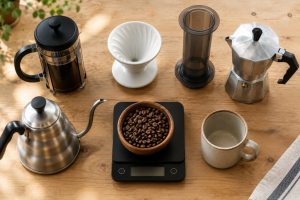
How to Choose the Best Coffee Brewing Method
The Best Coffee Brewing Method for Beginners
The best coffee brewing method for beginners depends on how much control you want. An automatic drip machine is convenient, while a French press requires little equipment and offers a straightforward process. A Kalita Wave is a useful starting point for people interested in manual pour-over without the learning curve of a more demanding technique.
The Best Coffee Brewing Method for Travel
The best coffee brewing method for travel should be compact, durable, and easy to clean. An AeroPress, phin, small pour-over dripper, or instant coffee can work well. Choose according to whether you will have access to hot water, a kettle, and a place to wash your equipment.
The Best Way to Brew Coffee at Home Without a Machine
If you do not own an electric coffee maker, consider a French press, moka pot, phin, pour-over dripper, or cowboy coffee. Instant coffee is another option when you only have access to hot water. A grinder and a kitchen scale can improve consistency, but they are not essential for every method.
The Best Brewing Method for Light Roast Coffee
Light roasts often benefit from methods that encourage sufficient extraction while preserving delicate aromas. A V60, Chemex, Kalita Wave, or siphon brewer can highlight floral, fruity, and bright characteristics. Experiment with a slightly finer grind or hotter water if the coffee tastes sour or underdeveloped.
The Best Brewing Method for Dark Roast Beans
Dark roasts often extract readily and can develop smoky, bitter flavors when over-extracted. Try a French press, automatic drip machine, or AeroPress with a moderate water temperature and a carefully adjusted brewing time. Espresso and moka pot brewing can also work well when the recipe is tuned to the beans.
The Best Brewing Method for Single-Origin Coffee
The best brewing method for single-origin coffee depends on the flavor profile you want to emphasize. Paper-filtered pour-over can showcase clarity and delicate aromas, while a French press emphasizes body and texture. There is no universally correct method: the same beans can produce different, equally enjoyable cups.
How to Brew Coffee Without Bitterness: Pour-Over Tips
When learning how to brew coffee without bitterness pour over, focus on extraction consistency rather than simply reducing brewing time.
- Use a consistent grind size appropriate for your dripper.
- Start with fresh coffee and clean brewing equipment.
- Measure coffee and water instead of guessing.
- Use an appropriate water temperature, adjusting for roast level.
- Pour evenly and avoid excessively disturbing the coffee bed.
- If the cup tastes harsh or drying, try a slightly coarser grind or a shorter brew time.
Coffee Brewing Method for Low Acidity Stomach
If you want a coffee brewing method for low acidity stomach, cold brew may be worth trying because it often tastes less acidic than hot-brewed coffee. However, perceived acidity is not the same as measured acidity, and cold brew is not guaranteed to prevent reflux or stomach discomfort.
Smaller servings, avoiding coffee on an empty stomach, and choosing a roast or preparation that suits your tolerance may help. Anyone experiencing persistent symptoms should seek appropriate medical advice.
Cold Brew vs. Iced Coffee Brewing Method
The cold brew vs iced coffee brewing method comparison comes down to how the coffee is extracted. Cold brew uses cold or room-temperature water over many hours. Iced coffee is generally brewed hot and then cooled over ice or refrigerated.
- Cold brew: Often smooth and mellow, with a long preparation time.
- Flash-chilled coffee: Brewed hot directly onto ice, preserving a brighter flavor profile.
- Cold drip: Uses a slow stream of cold water passing through coffee grounds.
Choose cold brew if you prefer a mellow, make-ahead drink. Choose flash-chilled coffee if you want an iced coffee with more of the aromatic character associated with hot extraction.
Understanding Coffee Brewing Temperature
Coffee brewing temperature is one of the easiest dials to adjust. Hot water pulls out soluble compounds quickly, while cold water relies on time instead. There is no universal perfect setting, so adjust gradually and taste the difference
Meanwhile, coffee brewing temperature affects the speed at which soluble compounds are extracted. As a practical starting point, many hot-brewing recipes use water around 90–96°C, although the ideal temperature varies with roast level, grind size, and technique.
Light roasts may benefit from hotter water to encourage extraction, while dark roasts can sometimes taste more balanced at a slightly lower temperature. Cold brew uses a different extraction process and compensates for the absence of heat with a longer steep.
Temperature is only one variable. Grind size, coffee-to-water ratio, water quality, and contact time must also work together to produce a balanced cup.
Frequently Asked Questions
1. Which coffee brewing method produces the strongest coffee?
Espresso and moka pot coffee are concentrated, but strength can refer to either concentration or total caffeine. A larger drip coffee may contain more total caffeine than a small espresso shot.
Strong coffee here can mean concentrated, bitter, dark-roasted, heavy-bodied, or high in caffeine.
2. Which brewing method is easiest to use every day?
An automatic drip machine, French press, AeroPress, or phin can all be practical daily options. The best choice depends on your preferred flavor, available time, and cleanup requirements.
3. Is French press coffee better than pour-over?
Neither method is objectively better. French press coffee has a fuller body because more oils and fine particles enter the cup, while paper-filtered pour-over generally produces a cleaner texture and highlights delicate flavors.
4. Does cold brew contain more caffeine than regular coffee?
It depends on the coffee-to-water ratio, brewing time, serving size, and whether the cold brew is a concentrate. Concentrated cold brew can contain substantial caffeine, but diluted servings vary widely.
5. Do I need an expensive coffee grinder?
No. A consistent grinder can improve flavor and repeatability, but you can begin with pre-ground coffee that matches your brewing method. Upgrade when you want more control over extraction and freshness.
6. What is the most environmentally friendly brewing method?
Reusable methods such as French press, moka pot, and metal-filter brewing avoid single-use pods and reduce some disposable waste. The overall environmental impact also depends on equipment lifespan, energy consumption, coffee sourcing, and cleaning practices.
7. Is cold brew less acidic than hot coffee?
It tastes smoother and less sour, but research shows pH can be similar. Perceived sourness and titratable acidity differ more than pH.
8. Which method has the most caffeine?
Espresso has the most caffeine per milliliter, but a full mug of filter coffee can contain more total caffeine because the serving is larger.
9. Does paper or metal filtration taste better?
Neither is better. Paper gives clarity, while metal allows more oils and fine particles for a heavier body.
Conclusion: Find the Coffee Brewing Method That Suits You
There is no single coffee brewing method that produces the perfect cup for everyone.
Each method preserves something, removes something, and asks the bean a different question. Whether you pull an espresso shot, plunge a French press, or let cold brew steep overnight, the real craft lies in how water moves through roasted coffee. Pick the method that fits your taste, schedule, and equipment, then refine it one variable at a time.
Espresso emphasizes concentration and pressure, French press highlights body, pour-over reveals delicate flavors, and cold brew offers a convenient alternative for people who enjoy mellow iced coffee.
Traditional methods such as Turkish coffee, Vietnamese phin, South Indian filter coffee, and Arabic qahwa also demonstrate that coffee is more than a drink. It is an expression of culture, craftsmanship, and personal preference.
Key takeaways:
-
- Choose a brewing method based on your preferred taste, texture, and daily routine.
- Control grind size, water temperature, brewing time, and coffee-to-water ratio for more consistent results.
- Use paper filters when you want a cleaner cup and to reduce the amount of coffee oils in your drink.
- Experiment with different methods before investing in expensive equipment.
- Remember that the same beans can produce very different drinks depending on how you brew them.
- Six controls shape every cup: ratio, grind, time, temperature, pressure, and filtration.
- Espresso uses about nine bars of pressure, while a moka pot uses about 1.5.
- Paper filters give clarity, metal adds body, and no filter leaves sediment.
- Cold brew tastes smooth but is not guaranteed to be lower in chemical acidity.
- Beginners should start with a French press or Kalita Wave.
- The AeroPress and phin are great for travel.
- A quality grinder matters more than fancy equipment.
Start with one method, learn how it responds to small adjustments, and explore other techniques as your preferences develop. The best cup of coffee is the one that delivers the flavor and experience you enjoy.
