
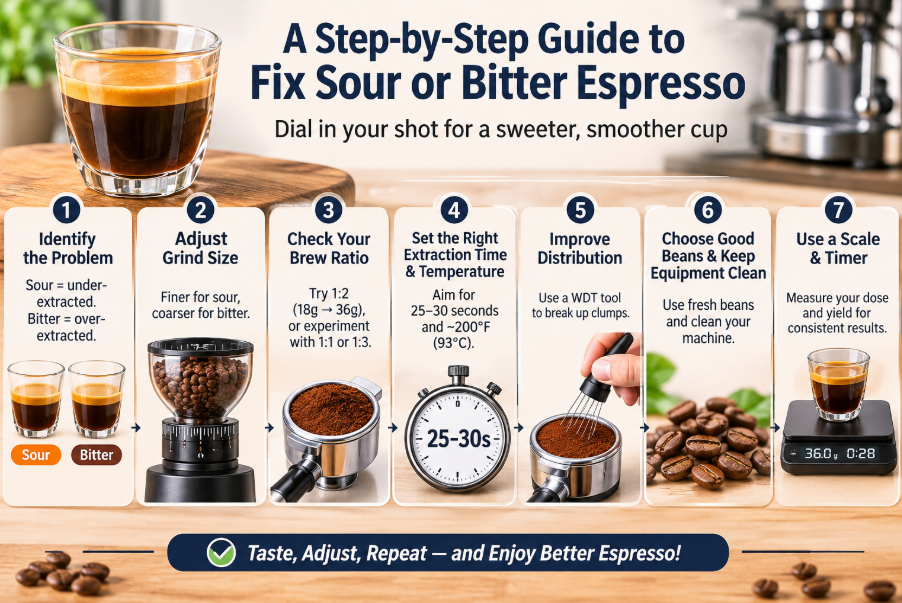
Why My Espresso Shot Tastes Sour, Bitter & Burnt and How to Fix It
Does your espresso taste unpleasantly sour or bitter? You’re not alone.
Getting a balanced espresso shot can take some experimentation, especially when you’re adjusting grind size, water temperature, and extraction time. The good news is that you don’t necessarily need a new espresso machine or expensive equipment to improve the flavor.
Sour espresso often indicates under-extraction, while excessive bitterness can be associated with over-extraction, dark roasts, stale coffee oils, or uneven extraction. However, several variables can produce similar flavors, so it’s important to make adjustments gradually.
In a glance, to fix sour or bitter espresso starts with one idea: espresso recipes change taste and extraction. Grind size, brew time and ratio are the hidden tools every home barista has.
In this guide, you’ll learn how to identify sour and bitter espresso, understand their common causes, and make practical adjustments to get a sweeter, smoother, and more balanced shot.
Why Espresso Tastes Sour or Bitter: Understanding Extraction
Before you touch your grinder, you need to understand what is happening in the puck. Coffee extracts in a predictable order: sour, sweet, then bitter. Acids and fats dissolve first, sugars follow, and plant fibers dissolve last. Stop the shot too early and the acids dominate. Push it too far and the woody, bitter compounds take over.
The Sour, Sweet, Bitter Sequence
Think of extraction as a journey with three stops. The first stop is bright, sharp acidity. The second is the sweet zone, where balance lives. The third is bitterness and dryness. Your goal is to stop in the middle. A useful reminder many coffee professionals repeat: there is no such thing as a sour coffee, only sour extractions. A coffee can be acidic, which may be lovely, but sourness usually points to extraction.
Under-Extracted vs. Over-Extracted: Two Kinds of Bitter
Here is where it gets tricky. Bitterness can come from either side of the sweet spot.
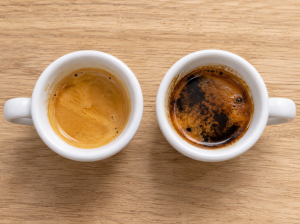
- Under-extracted bitterness: caused by a heavy load of fines and cell wall fragments washing into the cup, often visible as dark specks or tiger striping. It is common in small, ristretto-style shots.
- Over-extracted bitterness: a drying, tannin-like feeling on the tongue, a thinner and more watery body, and a lingering finish.
If your shot dries out your mouth and tastes watery, you have likely gone too far. If it is sharp, pungent or salty, you are probably on the under-extracted side.
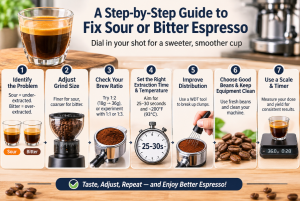
1. Understand the Difference Between Sour and Bitter Espresso
Before changing your espresso recipe, identify what you’re actually tasting. Sourness and bitterness can sometimes be confused, but they usually provide different clues about your coffee extraction.
What Does Sour Espresso Taste Like?
Sour espresso often tastes tart, sharp, or similar to an underripe fruit. It may leave an acidic sensation on your tongue without the sweetness and body you’d expect from a balanced shot.
Some light-roasted coffees naturally have brighter acidity. However, if the espresso tastes excessively sour or unpleasantly sharp, under-extraction may be contributing to the problem.
Additionally, sourness hits immediately at the front of the sip. It is sharp, high-toned and fades quickly. Many tasters describe it as an under-ripe, tart fruit note. Under-extraction can also taste salty or savory
What Does Bitter Espresso Taste Like?
Bitter espresso can leave a lingering, dry, or medicinal taste. Some people describe it as similar to plant fibers, burnt coffee, or aspirin-like bitterness.
Bitterness can come from dark-roasted beans, excessive extraction, uneven water flow, or old coffee oils left inside the grinder and espresso machine.
On the other side, bitterness creeps in. It lingers, feels low rather than high, and leaves a drying or clawing sensation, a bit like chewed aspirin or plant fiber.
Why Identifying the Flavor Matters
The distinction helps you decide which variable to adjust first. For example, a sour shot that runs too quickly may benefit from a finer grind. A bitter shot that runs unusually slowly may need a coarser grind or a different dose.
Don’t assume every sour shot is under-extracted or every bitter shot is over-extracted. Channeling and uneven extraction can sometimes create a combination of sour and bitter flavors.
2. Adjust Your Espresso Grind Size
Grind size is one of the most important variables affecting espresso extraction. It determines how easily water moves through the coffee puck and how much time water has to extract flavor compounds.
How to Fix Sour Espresso With a Finer Grind
If your espresso tastes sour and flows too quickly, try grinding your coffee finer. Smaller coffee particles create more resistance, slowing the water and giving it more contact time with the grounds.
This can help extract more sweetness and balance from the coffee, reducing the sharp taste associated with under-extraction.
How to Fix Bitter Espresso With a Coarser Grind
If your espresso tastes excessively bitter and takes too long to extract, try a slightly coarser grind. Larger particles generally allow water to pass through the coffee puck more easily.
Make small adjustments rather than changing the grinder dramatically. A large change can move your extraction too far in the opposite direction.
Watch for Channeling
Grinding too fine can sometimes create excessive resistance and encourage uneven water flow through the puck. This is known as channeling.
When water finds easier paths through the coffee, some areas may become over-extracted while others remain under-extracted. The resulting espresso can taste both sour and bitter.
3. Check Your Espresso Brew Ratio
Your brew ratio describes the relationship between the amount of ground coffee you use and the amount of espresso you produce. It has a significant influence on strength, body, and flavor.
Start With a 1:2 Espresso Ratio
A useful starting point for a double espresso is:
- Coffee dose: 18 grams
- Espresso yield: 36 grams
- Brew ratio: 1:2
- Extraction time: Approximately 25–30 seconds
This is a starting recipe rather than a universal rule. Different coffee beans, roast levels, baskets, and machines may require different ratios and extraction times.
Experiment With Ristretto and Lungo
If your espresso still tastes unbalanced, experiment with the amount of liquid you produce.
- Ristretto (1:1): Use 18 grams of coffee to produce approximately 18 grams of espresso. This creates a shorter, more concentrated shot.
- Standard espresso (1:2): Use 18 grams of coffee to produce approximately 36 grams of espresso.
- Lungo (1:3): Use 18 grams of coffee to produce approximately 54 grams of espresso. This produces a longer shot.
Compare the results and choose the ratio that produces the best balance for your beans. Changing the yield can affect both strength and extraction, so taste each adjustment rather than relying on the ratio alone.
Ideal Espresso Brew Ratio Sour vs Bitter
The ideal espresso brew ratio sour vs bitter fix is simple: lengthen for sour, shorten for bitter.
- Sour espresso: let the shot run longer without changing anything else. If you are at 20 grams in and 40 out, try 45 to 50 out. Even five extra grams can make a big difference. A lungo-style 1:3 shot with a slightly coarser grind can soften the bright, fruity acidity common in light roasts.
- Bitter espresso: pull a shorter shot. Try a 1:1 ratio with the grind one step finer for a thicker, sweeter cup that stops before the final bitter compounds arrive. It also suits dark roasts well.
For bigger ratios, such as 1:3, you may need to cut more output, for example 20 grams less, to see the same change.
4. Adjust Extraction Time and Water Temperature
Extraction time and brewing temperature influence how coffee compounds dissolve into your espresso. If your shot tastes sour, these variables may need attention.
Use Extraction Time as a Starting Point
For an 18-gram dose producing 36 grams of espresso, approximately 25–30 seconds is a common starting range.
If the shot finishes in around 15 seconds and tastes sharp or sour, the water may be passing through too quickly. Try grinding finer and observe whether the extraction becomes more balanced.
In one adjustment demonstrated in the source material, changing the grind and increasing the brewing temperature from 192°F to approximately 203°F helped improve a shot from around 15 seconds to approximately 30–31 seconds. The resulting espresso developed sweeter fruit notes.
These figures are examples, not settings that every machine or coffee should use.
Increase Temperature for Some Light Roasts
Light-roasted coffee can be more challenging to extract than darker coffee. A higher brewing temperature may help extract more flavor and reduce excessive sourness.
If your machine allows temperature adjustment, experiment with small changes while keeping your dose and yield consistent.
Avoid Changing Too Many Variables at Once
Changing grind size, temperature, dose, and brew ratio simultaneously makes it difficult to understand which adjustment improved the flavor.
Instead, change one variable at a time, pull another shot, and record the result. This makes dialing in espresso much easier and more repeatable.
5. Improve Coffee Distribution Before Tamping
Unevenly distributed coffee grounds can cause water to flow through the puck inconsistently. This may lead to channeling, uneven extraction, and unpleasant sour or bitter flavors.
Use a WDT Tool to Break Up Coffee Clumps
A Weiss Distribution Technique (WDT) tool uses thin needles to break up clumps and distribute coffee grounds more evenly inside the portafilter basket.
To use one:
- Grind your coffee directly into the portafilter basket or transfer the grounds carefully.
- Insert the WDT needles into the coffee grounds.
- Move the tool gently through the grounds to break up clumps.
- Distribute the coffee evenly across the basket.
- Level the surface and tamp consistently.
Keep Your Tamping Technique Consistent
Apply a consistent, level tamp every time. Once the coffee puck is properly compressed, tamping harder is not a reliable way to control extraction speed.
Focus instead on even distribution, consistent dosing, and appropriate grind size. These factors provide more useful control over water flow.
6. Choose the Right Coffee Beans and Roast Level
The coffee beans themselves can strongly influence whether your espresso tastes bright, sweet, smoky, or bitter. Even with a well-adjusted machine, some roast profiles may not match your preferred flavor.
Light Roast Coffee
Light roasts often have brighter acidity and fruitier flavor characteristics. They can produce naturally acidic espresso, and they may require careful adjustments to grind size and brewing temperature to achieve a balanced extraction.
Medium Roast Coffee
Medium-roasted beans can offer a useful balance between acidity, sweetness, and body. If you find light roasts too sour and dark roasts too bitter, a medium roast may be a good place to start.
Dark Roast Coffee
Dark roasts generally have less perceived acidity and stronger roasted flavors. However, they can also produce smoky, burnt, or bitter notes, particularly when the coffee is extracted aggressively.
Give Freshly Roasted Beans Time to Degas
Freshly roasted coffee releases carbon dioxide. If beans are used too soon after roasting, excess gas can interfere with extraction and contribute to inconsistent results.
Espresso beans often benefit from a degassing period of approximately a week or longer, depending on the roast and storage conditions. Very fresh coffee may also produce noticeable foaming or bubbling in the cup.
Allowing beans to rest can help produce more consistent espresso. The ideal resting period varies, so use taste and extraction behavior as your guide.
7. Clean Your Espresso Machine and Grinder
Old coffee grounds and accumulated oils can create unpleasant flavors. Even if your grind size, dose, and extraction time are correct, dirty equipment may still make espresso taste bitter or stale.
Clean the Portafilter and Basket
Remove used coffee grounds after each shot and rinse the basket and portafilter. Pay attention to coffee residue around the basket edges and inside the portafilter.
Clean the Group Head
Wipe the group head regularly and follow your espresso machine manufacturer’s instructions for backflushing and deeper cleaning. Coffee residue around the group head can affect the flavor of future shots.
Clean Your Coffee Grinder
Old coffee particles and oils can accumulate inside the grinder, particularly around the burrs and grinding chamber. These residues may become stale and contribute unwanted bitterness.
Follow the manufacturer’s cleaning instructions and use suitable grinder-cleaning products when recommended. Regular maintenance helps keep your coffee flavor more consistent.
Use a Coffee Scale and Timer for Consistent Espresso
A coffee scale with a timer is a simple but valuable tool for diagnosing espresso problems. Without measuring your dose, yield, and extraction time, it can be difficult to repeat a successful shot.
For a basic espresso recipe, start by measuring 18 grams of ground coffee and aim for 36 grams of espresso in approximately 25–30 seconds.
Record the results and note how the espresso tastes. If it is sour and runs too quickly, try a finer grind. If it is bitter and runs too slowly, try a coarser grind or review your dose and extraction settings.
Keep the other variables consistent while testing. This simple approach makes it easier to identify what is causing the problem.
Why Is My Espresso Bitter? Common Causes Beyond the Grinder
If you keep asking, why is my espresso bitter, look beyond the grind setting. Several culprits hide in your coffee, machine and routine.
Coffee Quality and Roast Level
Specialty-grade coffee carries natural sweetness because coffee is a fruit. Commercial-grade coffee tends to taste flatter and more bitter. Robusta is also roughly twice as high in chlorogenic acids and caffeine as Arabica, which adds bitterness. And roast level matters: like bread in a toaster, a golden-brown roast is sweet and caramelized, while pushing further adds char and smoke.
Why Does My Coffee Taste Burnt?
If you are wondering why does my coffee taste burnt, check three things. First, the roast: dark, supermarket-style roasts often taste burnt because they are roasted dark to mask bitterness. Second, dirty equipment: coffee oils oxidize and turn harsh inside your grinder and machine, much like an old bottle of olive oil compared with a fresh one. Back-flush and deep clean on schedule. Third, the puck itself. A dry, crumbly puck can mean too much coffee in the basket, while a sloppy puck can mean the grind is too fine and water sat on top.
Water Temperature
Higher water temperatures dissolve more from the coffee, so lowering the boiler temperature can reduce bitterness on machines that allow it. Lighter roasts that taste sour often benefit from a hotter setting. Only change temperature in steps of at least one degree, since smaller changes are hard to taste.
Best WDT Tool for Bitter Espresso
The best WDT tool for bitter espresso is one that lets you stir all the way to the bottom of the basket and break up clumps so grounds are evenly distributed. Fine needles reduce channels, which lowers the chance that parts of the puck are over-extracted. Pair it with a dosing ring to keep grounds contained while you stir.
Coffee Scale With Timer to Fix Bitter Espresso
Dialing in depends on repeatable numbers. A coffee scale with timer to fix bitter espresso lets you track dose, yield and shot time together. Without it you are guessing. Weigh 18 or 20 grams in, stop at your target output and log the seconds.
Tamping and Consistency
Keep your tamp consistent and level, but do not expect a harder tamp to speed up or slow down flow once the grounds are fully compressed. Focus on grind size, time and ratio, the three big variables.
Step-by-Step: A Practical Dial-In Routine
- Set your baseline: 18 grams in, 36 grams out, about 25 to 30 seconds.
- Taste and identify: is it sharp and fast (sour) or lingering and drying (bitter)?
- Check the time: a very short shot points to a grind that is too coarse; a very long, low-yield shot points to a grind that is too fine and channeling.
- Change one variable: grind size first, then yield, then temperature.
- Keep prep identical: same dose, same WDT, same tamp.
- Repeat and record: note each change so you can retrace your steps.
Frequently Asked Questions
Why Does My Espresso Taste Sour?
Sour espresso can result from under-extraction, a grind that is too coarse, a shot that runs too quickly, or a brewing temperature that is too low. Light-roasted beans also naturally have brighter acidity. Try adjusting one variable at a time to identify the cause.
Why Does My Espresso Taste Bitter?
Excessive bitterness can be associated with over-extraction, very fine grinding, dark-roasted beans, stale coffee oils, or uneven extraction. Check your shot time, grind size, coffee dose, and equipment cleanliness.
Should I Grind Finer or Coarser for Sour Espresso?
If your sour espresso also runs too quickly, try grinding finer to slow the water flow and improve extraction. However, if the shot already runs slowly or shows signs of channeling, investigate distribution and other variables before making the grind finer.
What Is the Best Espresso Ratio for Beginners?
A 1:2 brew ratio is a practical starting point. For example, use 18 grams of ground coffee to produce approximately 36 grams of espresso. Adjust the ratio according to your beans and preferred taste.
Does Water Temperature Affect Espresso Taste?
Yes. Brewing temperature influences extraction. A higher temperature may help extract light-roasted coffee, while a temperature that is too low can contribute to under-extraction. The ideal setting depends on the beans and machine.
How Long Should Fresh Coffee Beans Rest Before Making Espresso?
Espresso beans often benefit from resting for about a week or longer after roasting to allow carbon dioxide to escape. The ideal period depends on the roast level and storage conditions.
Why Is My Espresso Sour Even With Fine Grind?
This is one of the most common frustrations, and it has a counterintuitive answer. If you pull 20 grams in and 30 grams out and it takes 50 seconds, water is not flowing evenly. It is racing through a few channels while the rest of the puck barely gets touched. That means most of the coffee is under-extracted and a few spots are over-extracted. So why is my espresso sour even with fine grind? Because a grind that is too fine can cause channeling. The solution is to coarsen the grind, shorten the time and let water flow evenly through the entire puck.
How Do I Know If My Espresso Is Sour or Bitter?
Sour hits immediately, feels sharp and fades fast. Bitter creeps in slowly, feels low and drying, and lingers.
Should I Grind Finer or Coarser for Sour Espresso?
If the shot ran fast, go finer. If the shot was long but low in yield, go coarser to avoid channeling. You can also simply pull a few more grams of output.
Does a Harder Tamp Fix Sour Espresso?
No. Once grounds are fully compressed, extra force does not meaningfully change flow. Adjust grind size, time and ratio instead.
Can a Darker Roast Reduce Sourness?
Yes. Darker roasts burn away more acids, so moving one roast level darker can sweeten a sour cup. Just avoid going so dark that burnt or smoky bitterness appears.
Conclusion: Get Better Espresso by Making Small Adjustments
Fixing sour or bitter espresso is mostly about understanding extraction and making controlled adjustments. Start by identifying the flavor, then check your grind size, brew ratio, extraction time, and water temperature.
Use a WDT tool to improve coffee distribution, choose beans that suit your taste, and keep your espresso machine and grinder clean. A coffee scale and timer can also help you repeat successful shots and understand what needs changing.
Most importantly, change one variable at a time. With a little experimentation, you can move away from sharp, sour, or unpleasantly bitter espresso and get a more balanced cup with better sweetness and flavor.
Key Takeaways
-
- Sour espresso can indicate under-extraction, although some beans naturally have brighter acidity.
- Bitter espresso may be related to excessive extraction, dark roasts, uneven water flow, or stale coffee oils.
- Try a finer grind when a sour shot runs too quickly.
- Try a coarser grind when a bitter shot runs too slowly, while checking for other extraction problems.
- Start with an 18-gram dose and a 36-gram yield as a basic 1:2 espresso recipe.
- Allow freshly roasted beans time to degas before dialing in espresso.
- Clean your grinder, portafilter, basket, and group head regularly.
- Change one variable at a time and use a scale and timer to track your results.
- Coffee extracts sour, then sweet, then bitter. Aim for the middle.
- Sour is sharp and fast; bitter is slow, low and drying.
- Fast and sour: grind finer or pull a longer yield.
- Slow and low-yield: grind coarser to prevent channeling.
- Bitter: try a shorter ratio such as 1:1, a lower temperature or a lighter roast.
- Use a WDT tool, a scale with a timer and a clean machine for consistent results.
Sour and bitter espresso are signals, not verdicts. Once you learn to read them, you can steer a shot back to the sweet middle with small, deliberate changes. Taste carefully, change one thing at a time, keep your prep consistent and keep your equipment clean. Within a few shots you will taste the difference.

One thought on “How to Fix Sour or Bitter Espresso: Easy Guides & Tips”